Ellsworth Kelly
1923 - 2015
Ellsworth Kelly Biography
1923 - 2015
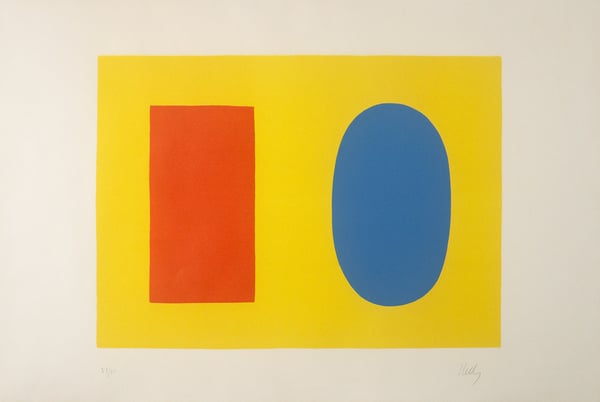
Ellsworth Kelly was a significant American painter, sculptor, and printmaker, recognized for his foundational contributions to hard-edge painting, Color Field painting, and Minimalism. Born on May 31, 1923, in Newburgh, New York, Kelly served in the United States Army during World War II from 1943 to 1945. Following his military service, he pursued formal art education at the School of the Museum of Fine Arts in Boston, where he studied from 1946 to 1948.
In 1948, Kelly moved to Paris under the G.I. Bill. During his six years in France, he engaged with the European avant-garde and studied the works of artists such as Jean Arp, Constantin Brancusi, and Henri Matisse. This period proved formative, as he began to transition away from figurative art toward an emphasis on pure form, line, and color. It was during this time that he began experimenting with the multi-panel and shaped canvases that would define much of his later practice.
Kelly returned to the United States in 1954, settling in New York City. He became associated with a generation of artists who moved away from the gestural techniques of Abstract Expressionism in favor of structured, objective abstraction. His work focused on the relationship between color and the physical space occupied by the artwork. He explored the use of monochrome panels and the reduction of subject matter to essential geometric shapes, often inspired by his observations of both the built and natural environments.
Throughout his career, Kelly maintained an extensive exhibition history at major public institutions. His work is included in the permanent collections of numerous international museums, including the National Gallery of Canada, the Museum of Modern Art in New York, and the Tate in London. He was elected a member of the American Academy of Arts and Letters in 1996. Kelly continued to produce work until his death on December 27, 2015, in Spencertown, New York.