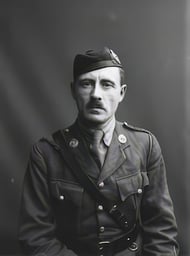
Cyril H. Barraud
1877 - 1965
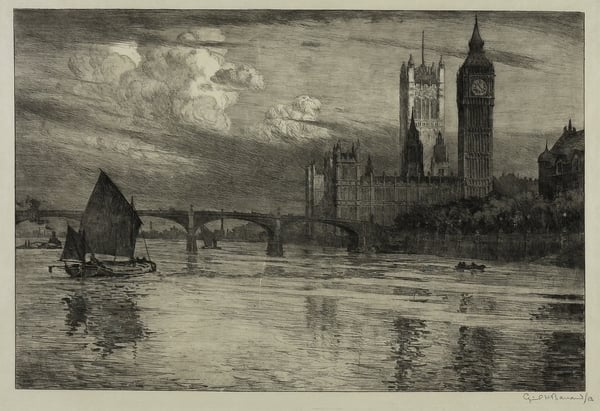
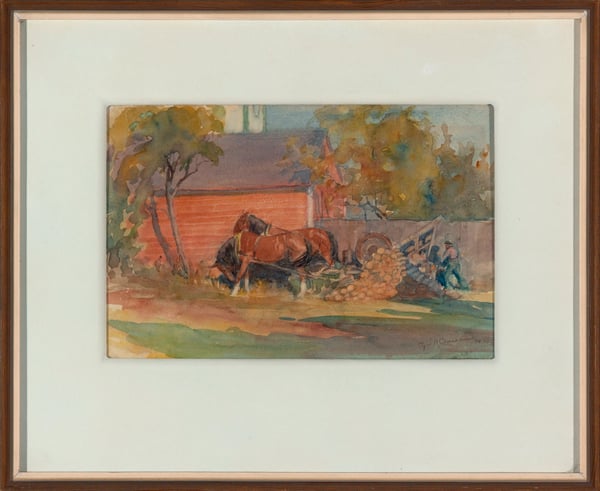
Cyril H. Barraud Biography
1877 - 1965
Cyril Henry Barraud was born in Barnes, Surrey, in 1877. He received his early artistic training at the Brighton School of Art before working in his father’s photography studio in London. In his early years, he assisted his uncle, Francis Barraud, with the final versions of the iconic "His Master’s Voice" painting. Barraud immigrated to Canada in 1913, settling in Winnipeg, where he quickly became a foundational figure in the provincial arts community. He served as the President of the Manitoba Society of Artists and Craftsmen and was a founding member of the Winnipeg Art Club in 1915.
During his tenure in Winnipeg, Barraud was a significant educator and mentor. He taught at the Winnipeg School of Art from 1913 to 1915, where he notably introduced Walter J. Phillips to the technical complexities of etching. His own artistic practice during this period focused on landscape painting and printmaking, with his work being exhibited regularly with the Royal Canadian Academy of Arts (RCA). His mastery of the intaglio process made him one of the few professional etchers active in Western Canada prior to the First World War.
In May 1915, Barraud enlisted in the Winnipeg Grenadiers and served with the 43rd Battalion of the Canadian Expeditionary Force. After being wounded in the leg in 1916, he was appointed an Official War Artist for the Canadian War Records in 1917. During his service, he produced over 300 sketches and paintings documenting the devastation of the European landscape, particularly around Ypres and Mont St. Eloy. Many of these field sketches were later developed into full print editions, serving as a primary visual record of the Canadian military experience in France and Belgium.
Following his demobilization in 1919, Barraud returned briefly to Canada before permanently resettling in England in the 1920s. He continued his professional practice in Suffolk and Essex, receiving commissions for topographical views and industrial scenes, including works used in railway carriage prints for the London and North Eastern Railway. He remained active in regional British art circles, including the Ipswich Art Club, until his death in 1965.
The work of Cyril Henry Barraud is represented in several major public and military institutions. His extensive body of wartime art is held in the permanent collections of the Canadian War Museum in Ottawa and the National Gallery of Canada. Additionally, his professional records are preserved in the archives of the Winnipeg Art Gallery and the Art Gallery of Ontario.