Alfred Worsley Holdstock
1820 - 1901
Alfred Worsley Holdstock Biography
1820 - 1901
Alfred Worsley Holdstock was a British-Canadian painter and educator recognized for his landscapes and pastoral scenes of 19th-century Canada. Born in Bath, England, in 1820, he received his formal education at Oxford University before immigrating to Montreal, Quebec, in 1850. Upon his arrival in Canada, he established himself as a drawing instructor, a profession he maintained from 1852 until 1873. During his tenure as an educator, he contributed to the instruction of visual arts in the region, eventually transitioning to focus exclusively on his own artistic practice in his later years.
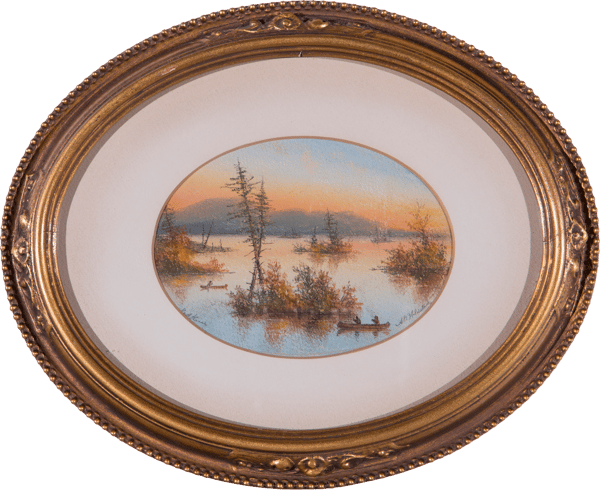
Holdstock’s body of work is primarily composed of watercolours and pastels, characterized by their detailed observation of the Canadian environment. His subject matter frequently focused on the geography of the Ottawa Valley, the Thousand Islands, the Laurentians, and the Eastern Townships. In addition to these topographical studies, his work provides a historical record of mid-to-late 19th-century Canada, capturing the daily lives of Indigenous peoples and the pastoral settings of rural settlements along the Red River and other waterways.
Throughout his career, Holdstock produced a significant volume of work that documented the evolving landscape of Eastern Canada. His compositions are often noted for their clarity and adherence to the picturesque traditions of the era. He continued his artistic output until his death in 1901.
Today, works by Alfred Worsley Holdstock are held in the permanent collections of major Canadian cultural institutions, including the National Gallery of Canada and the Musée national des beaux-arts du Québec. His contributions remain significant for their documentation of 19th-century Canadian geography and social history.