Guido Molinari
1933 - 2004 OC, RCA, LL.D.
Guido Molinari Biography
1933 - 2004 OC, RCA, LL.D.
Guido Molinari was born on October 12, 1933, in Montreal, Quebec, into an artistic family. His father, Charles Molinari, was a musician with the Orchestre des concerts symphoniques de Montréal and first president of the Quebec Musicians' Association, while his mother, Evelyne Dini, was the daughter of a sculptor.
Molinari began painting at age 13 and studied briefly at the School of the Art Association of Montreal under Marian Dale Scott and Gordon Webber from 1948-1951. He contracted tuberculosis a year later, and while convalescing, studied existentialism, reading authors such as Sartre, Camus, Piaget, and Nietzsche. He did not complete his formal training but found his own artistic path.
In 1955, Molinari held his first solo exhibition at L'Échourie and founded Galerie L'Actuelle with Fernande Saint-Martin, his future wife. This was the first gallery in Montreal to exclusively show abstract art. In 1956, he was a founding member of The Non-Figurative Artists' Association of Montreal.
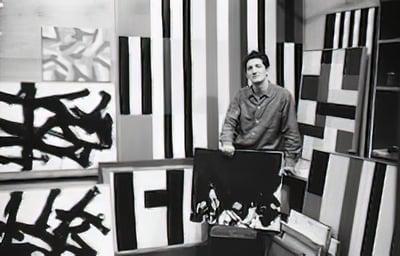
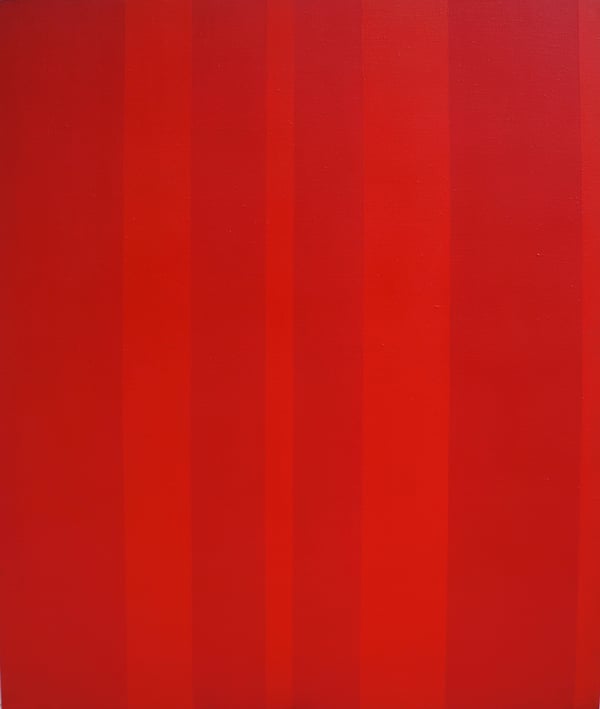
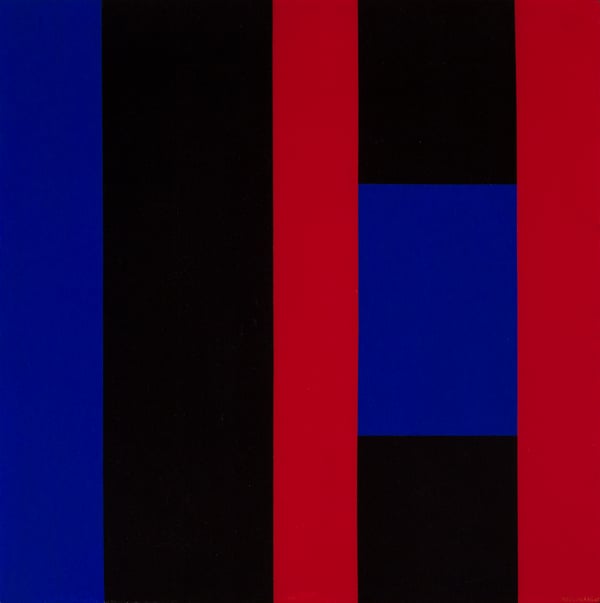
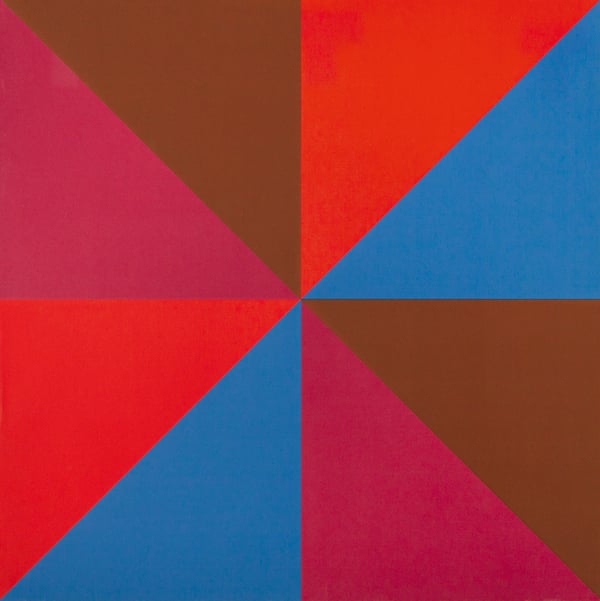
Between 1963 and 1969, Molinari created his celebrated Stripe series, consisting of hard-edge paintings with vertical bands of equal width on a flat picture plane. He described their effect as creating a new kind of fictional space "because it happens in the mind and yet also involves the totality of perception." In the late 1970s, he created the Quantificateur series, and in his final years, the Checkerboard paintings.
Molinari's work gained international recognition when he was selected by Lawrence Alloway for the Guggenheim International Award 1964 exhibition. In 1965, his work appeared in "The Responsive Eye" at the Museum of Modern Art in New York alongside artists like Frank Stella. He represented Canada at the 34th Venice Biennale in 1968, where he won the prestigious David Bright Prize.
Molinari taught for 27 years at Sir George Williams University and Concordia University, retiring in 1997. His theoretical writings and teaching influenced generations of younger Canadian artists. He was an avid art collector, owning works by Mondrian, Matisse, Jasper Johns, and Barnett Newman, among others.
Molinari received numerous honors including a Guggenheim Fellowship (1967), was made an Officer of the Order of Canada (1971), received the Victor Martyn Lynch-Staunton Award (1973), and won the Prix Paul-Émile-Borduas (1980). He was a member of the Royal Canadian Academy of Arts from 1969.
His work is held in major collections including the National Gallery of Canada, the Museum of Modern Art in New York, and international institutions. Molinari died of pneumonia on February 21, 2004, after battling bone cancer. Concordia University recognized him with a posthumous honorary doctorate that year.