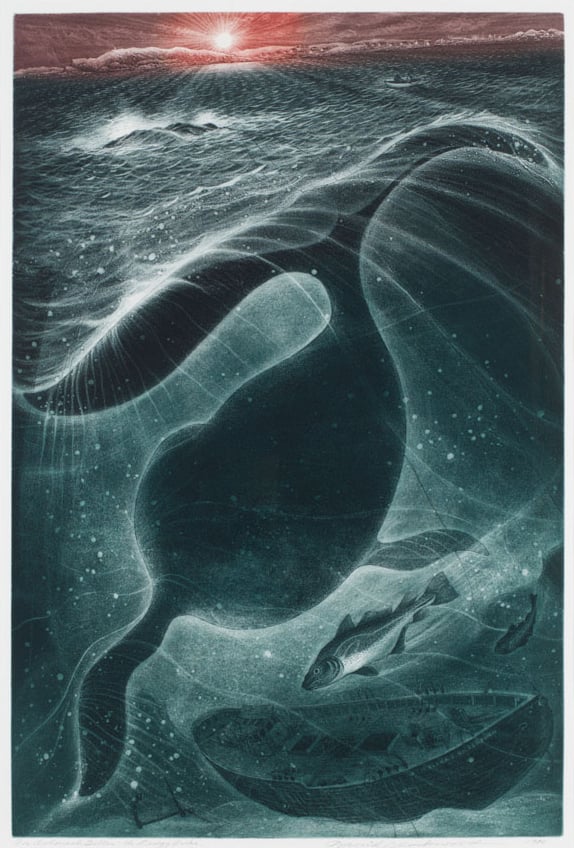
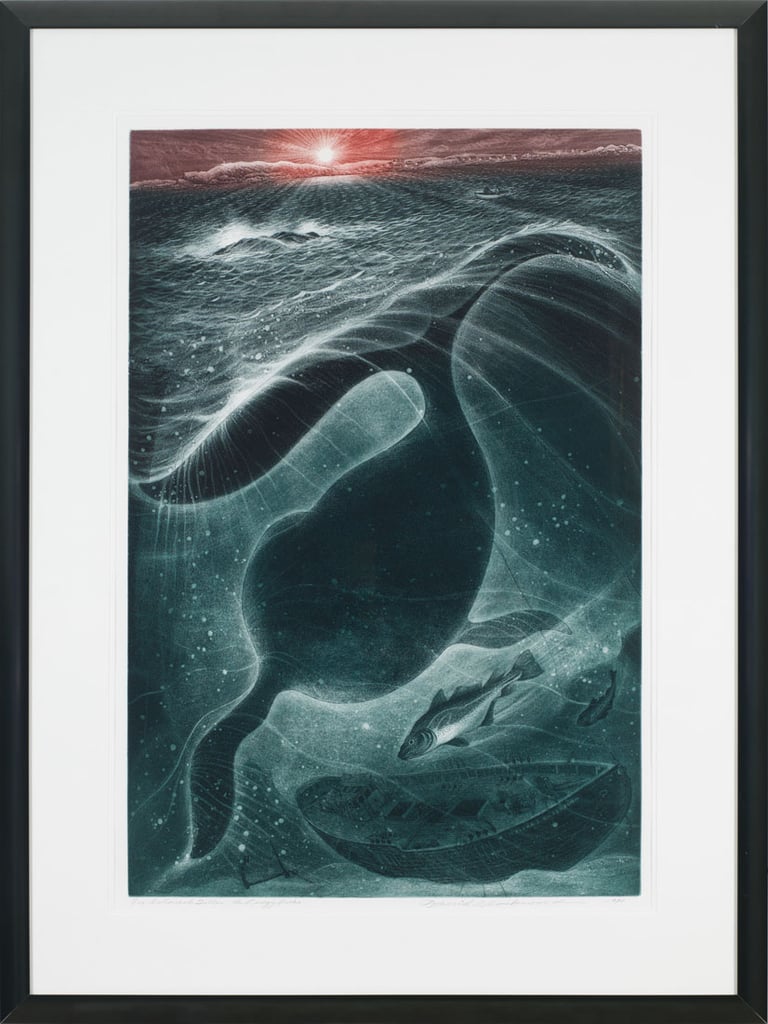
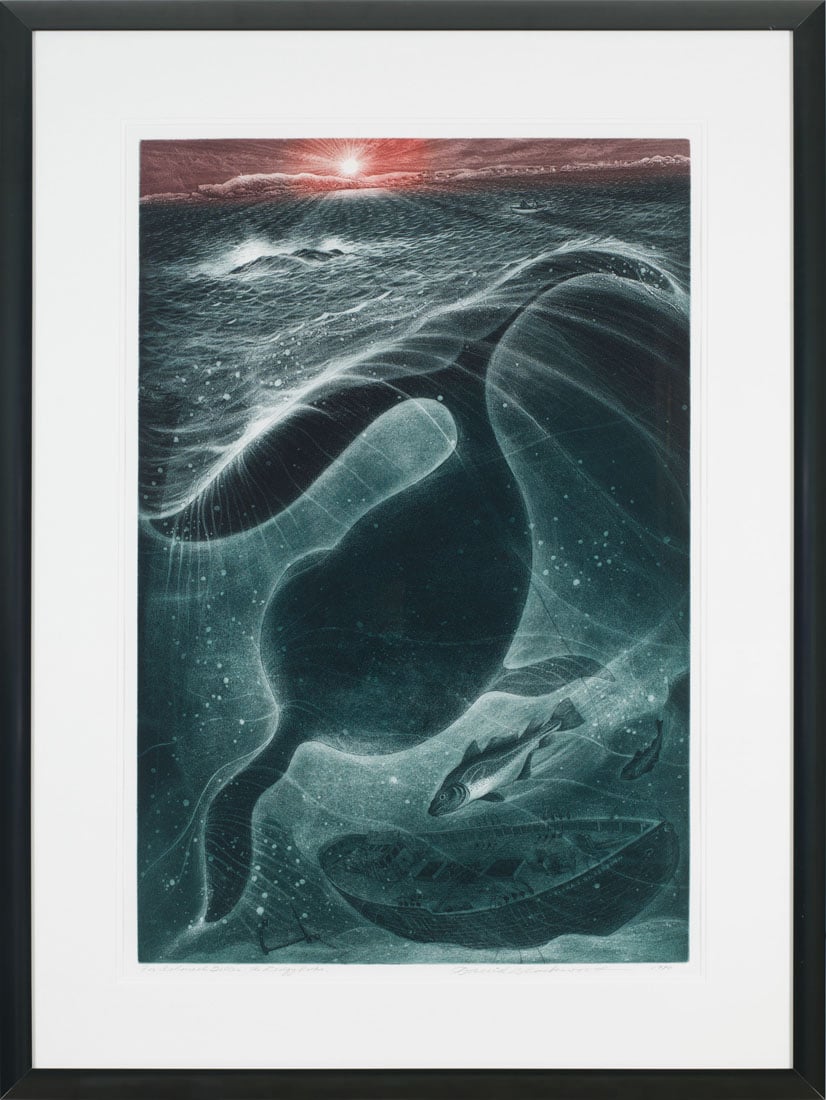
For Ishmael Tiller: The Ledgy Rocks
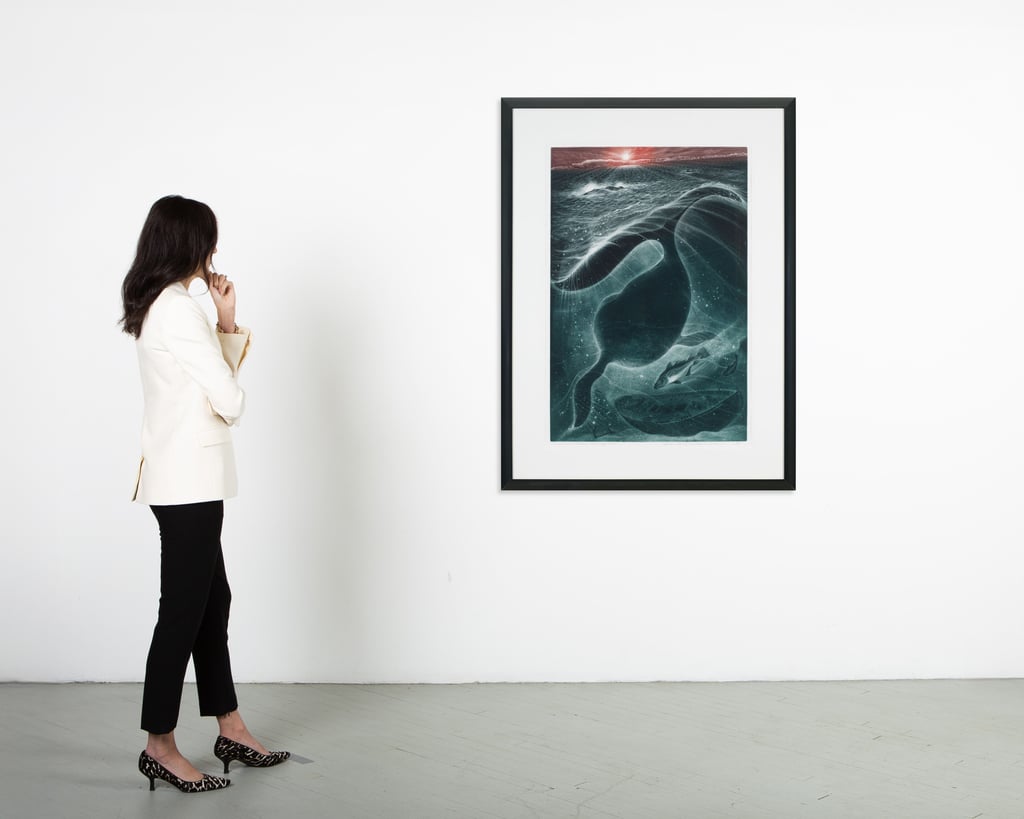
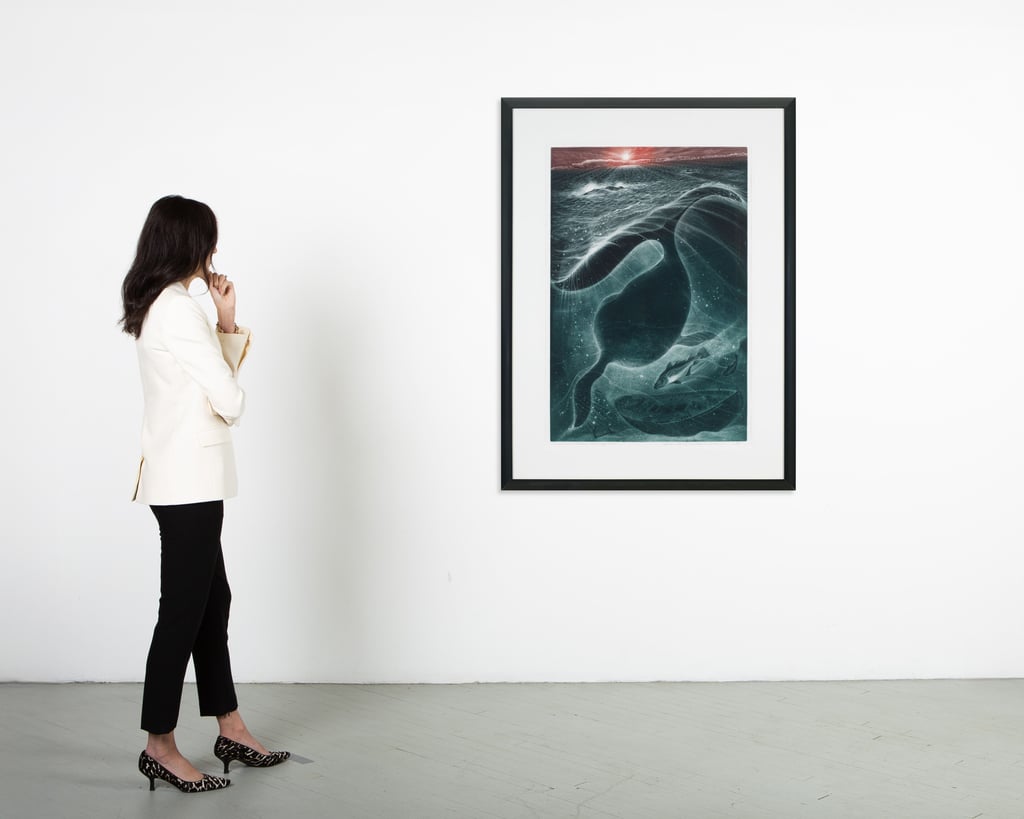
48 x 36 in (121.9 x 91.4 cm) including frame
David Blackwood is widely regarded as one of Canada’s most essential visual storytellers, known for creating a complex mythological universe rooted in the history of Newfoundland. Growing up in the fishing community of Wesleyville, Blackwood was deeply influenced by the oral traditions and maritime heritage of the outports. His work serves as a visual archive of a rugged, traditional way of life, elevated through his mastery of etching and aquatint. By the time of this 1990 print, Blackwood had achieved a national reputation for his ability to blend historical narrative with a haunting, supernatural atmosphere, securing his place as a definitive voice of the Atlantic coast.
The significance of the nautical and the whale in Blackwood’s oeuvre cannot be overstated; they represent the dual nature of the sea as both a provider and a predator. In For Ishmael Tiller: The Ledgy Rocks, the artist employs a dramatic cross-sectional perspective that bridges the world above the waves with the depths below. The whale is not merely a biological specimen but a monumental, spectral presence—an "underworld" force that dwarfs the human activity on the surface. This juxtaposition of the small fishing dory against the massive, ghost-like form of the whale underscores the vulnerability of those who make their living from the ocean.
Technically, this work showcases Blackwood’s sophisticated use of the "Lost Party" blue palette and the textural richness of aquatint. The composition is anchored by a sunken vessel on the seafloor, a recurring motif in his work that speaks to the tragedies inherent in Newfoundland’s history. The vibrant red glow of the sun on the horizon provides a startling contrast to the deep, atmospheric shadows of the water, creating a tension between hope and the ever-present danger of the "ledgy rocks." This print remains a powerful example of Blackwood's ability to transform specific regional memories into universal meditations on human endurance and the sublime power of nature.
David Blackwood
1941 - 2022 CM, RCA, O Ont
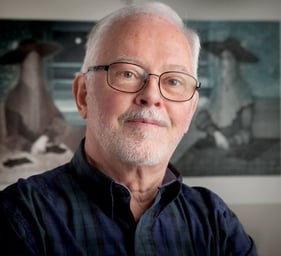
David Lloyd Blackwood was born in Wesleyville, Newfoundland, on November 7, 1941, to a family with a long seafaring history. Recognized for his artistic ability at an early age, he opened his first studio in 1956 at age fifteen. In 1959, he received a Government of Newfoundland Centennial Scholarship to study at the Ontario College of Art in Toronto, where he trained under instructors including John Alfsen, Carl Schaefer, William Roberts, Eric Freifeld, Rowley Murphy, and Jock MacDonald. After graduating in 1963, he moved to Port Hope, Ontario, where he became Art Master at Trinity College School, a part-time position that allowed him to continue his studio practice.
Blackwood's career advanced rapidly during the 1960s. By age twenty-three, the National Gallery of Canada had purchased one of his etchings. During this period, he developed one of the largest thematically linked series of prints in Canadian history, "The Lost Party," consisting of fifty etchings that depicted the Newfoundland sealing disaster of 1914. From 1969 to 1975, he served as the first Artist-in-Residence at Erindale College, University of Toronto, in Mississauga. In recognition of his contributions to establishing an art gallery there, the institution was named The Blackwood Gallery when it officially opened in 1992.
Throughout his career, Blackwood maintained his focus on Newfoundland subjects despite his Ontario residency. His work documented outport life, including the fisheries, seal hunting, resettlement, shipwrecks, and mummers. While best known for his stark blue-black etchings, he later experimented with watercolors and oil tempera. His artistic output was documented in four major publications: "The Wake of the Great Sealers" (1973), "The Art of David Blackwood" (1988), "David Blackwood: Master Printmaker" (2001), and "Black Ice: David Blackwood Prints of Newfoundland" (2011).
Blackwood's work received significant institutional recognition. He was a member of the Royal Canadian Academy of Arts and received honorary doctorates from Memorial University of Newfoundland and the University of Calgary in 1992. He was appointed to the Order of Canada in 1993 and the Order of Ontario in 2003. In 2003, he became Honorary Chairman of the Art Gallery of Ontario, the first practicing artist to hold this position. His work is held in major collections including the National Gallery of Canada, the Royal Collection at Windsor Castle, the National Gallery of Australia, the Uffizi in Florence, and the Montreal Museum of Fine Arts. The Art Gallery of Ontario created the Blackwood Research Centre in 2000 after acquiring a major collection of his prints. Blackwood died at his home in Port Hope on July 2, 2022, at age eighty.
More work by David Blackwood