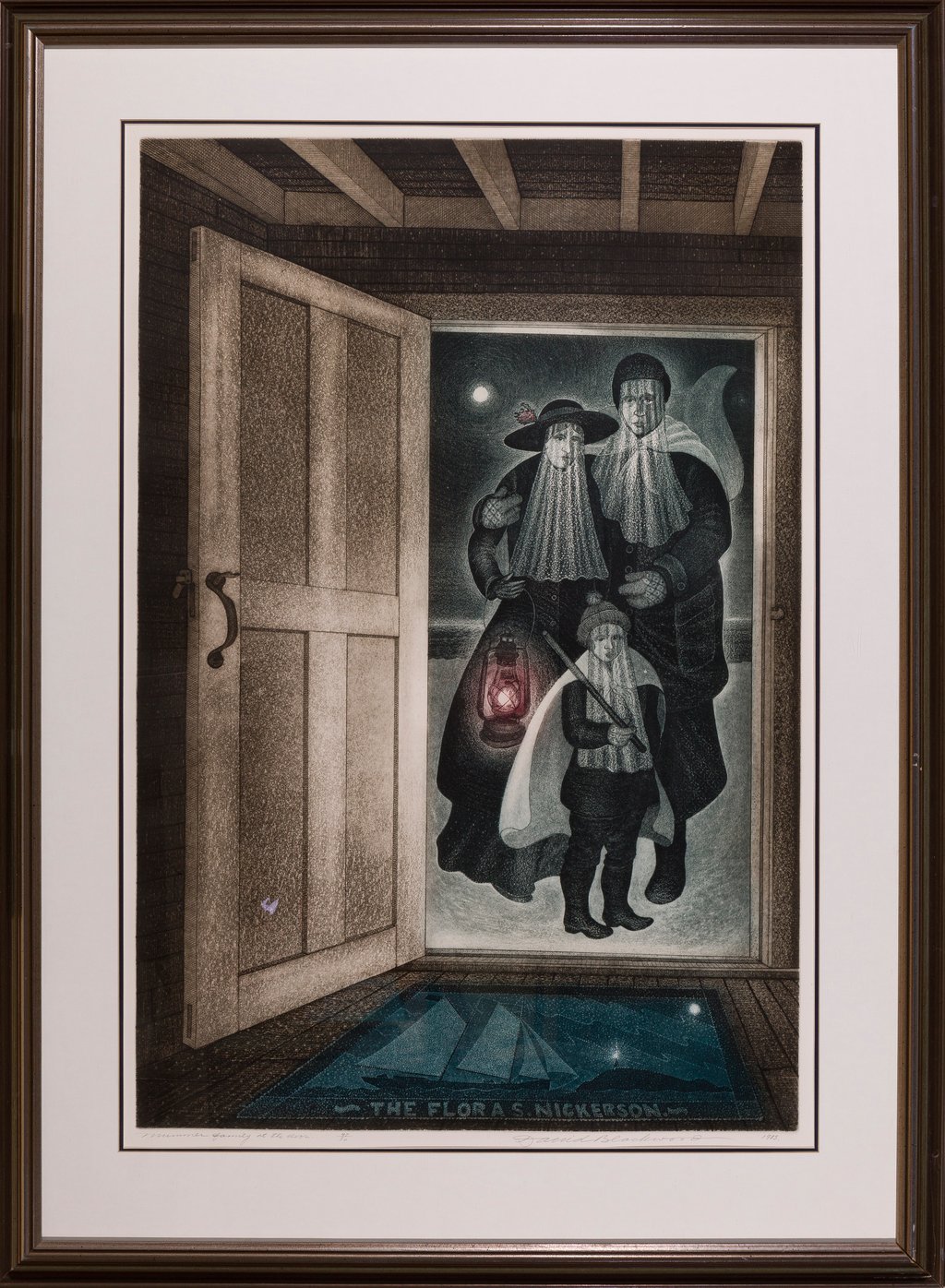
Mummer Family at the Door
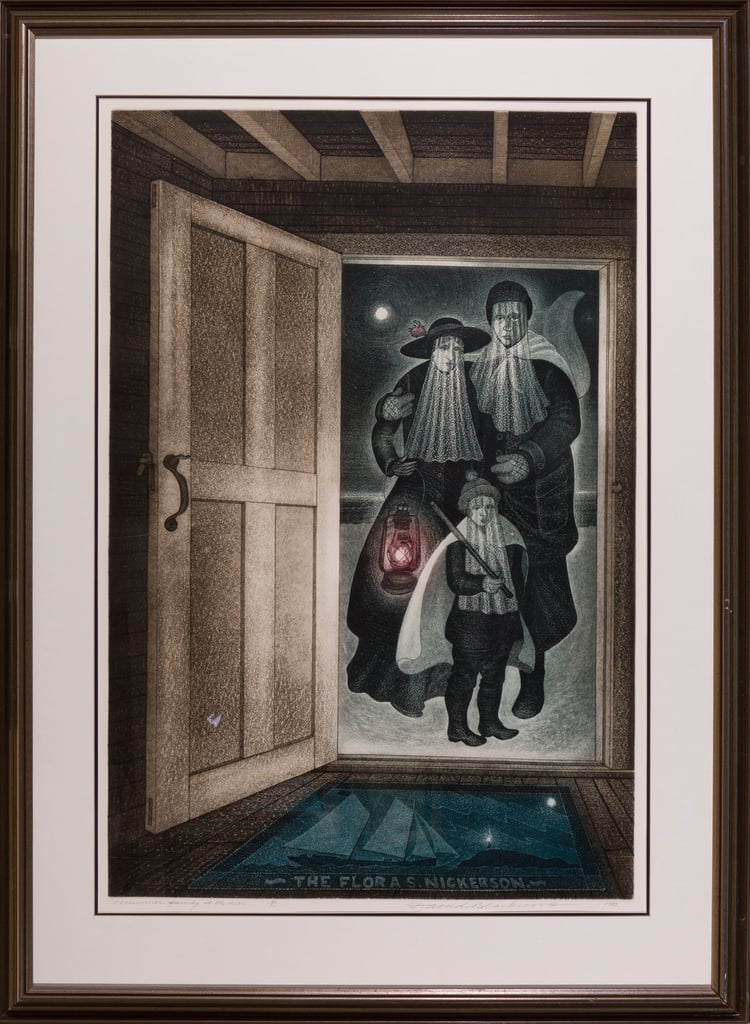
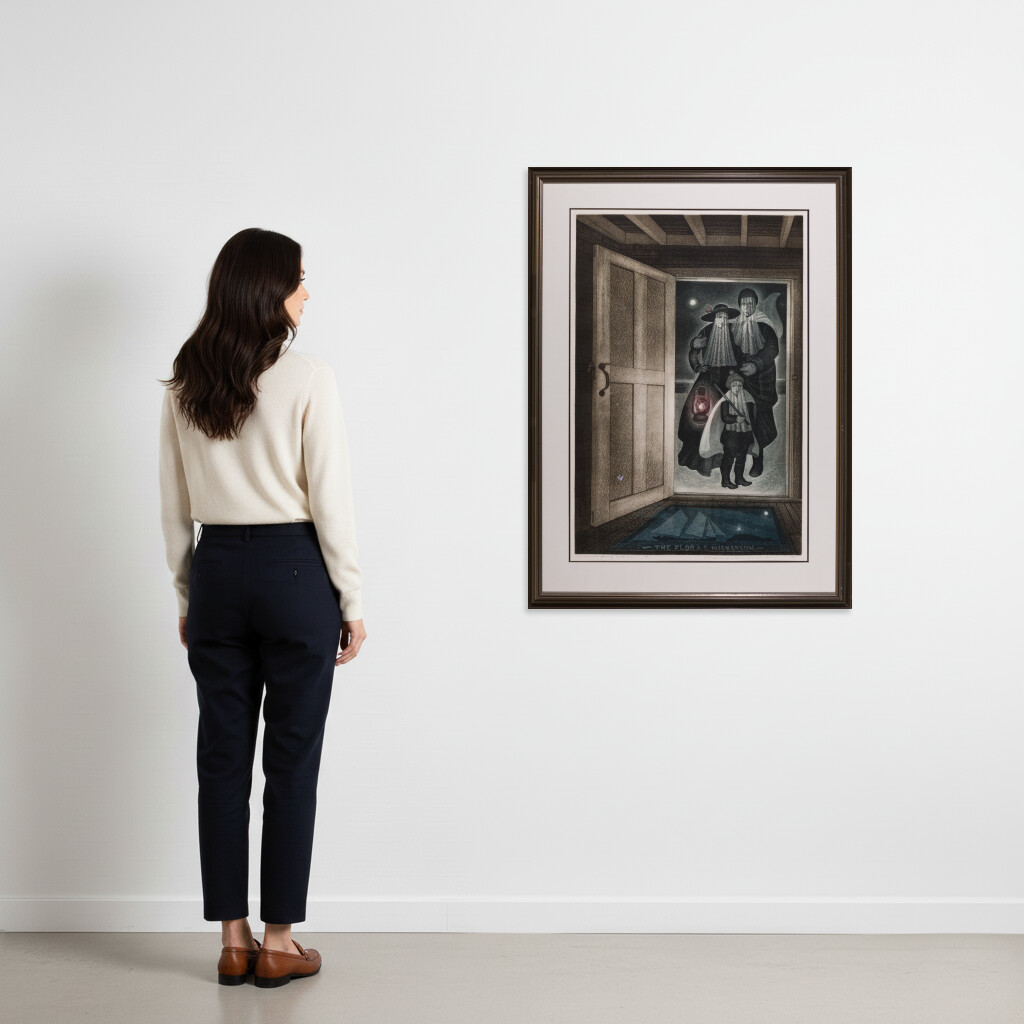
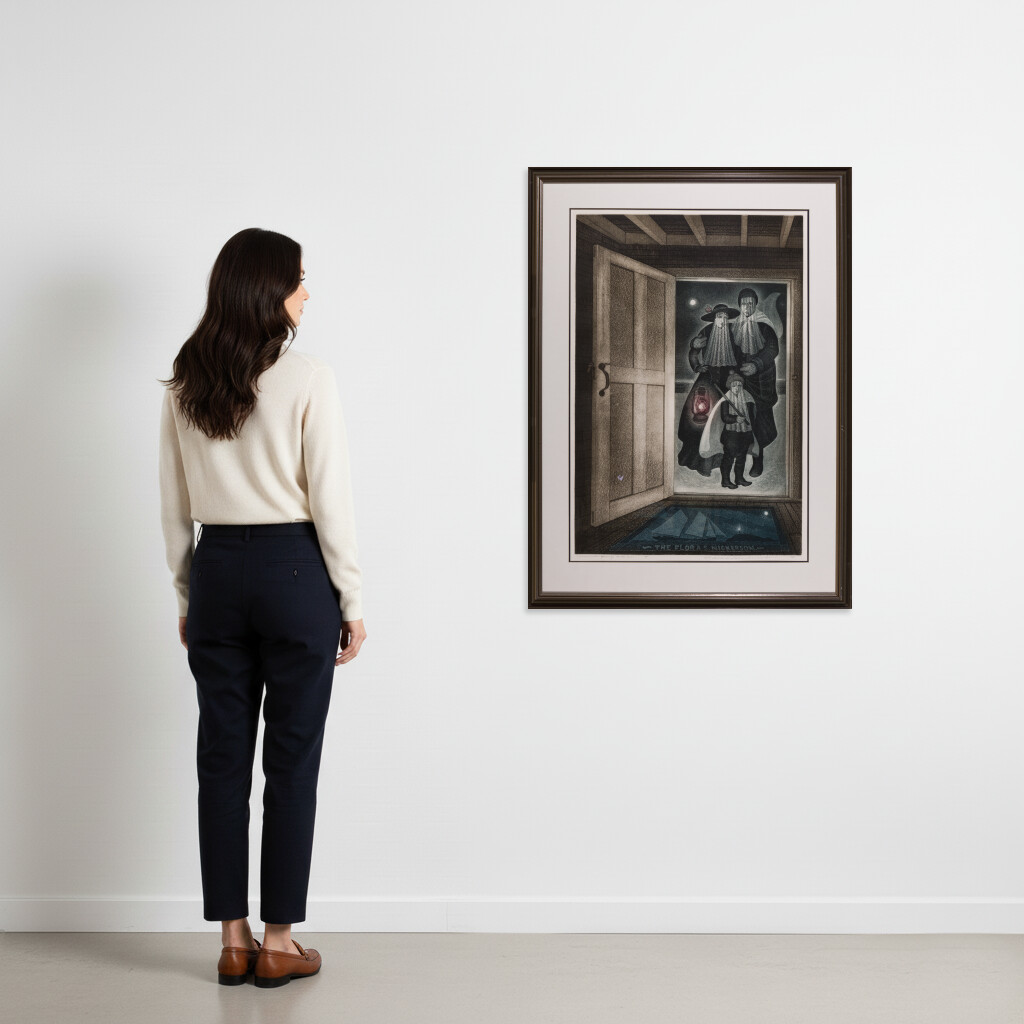
47 x 34.5 x 2 in (119.4 x 87.6 x 5.1 cm) including frame
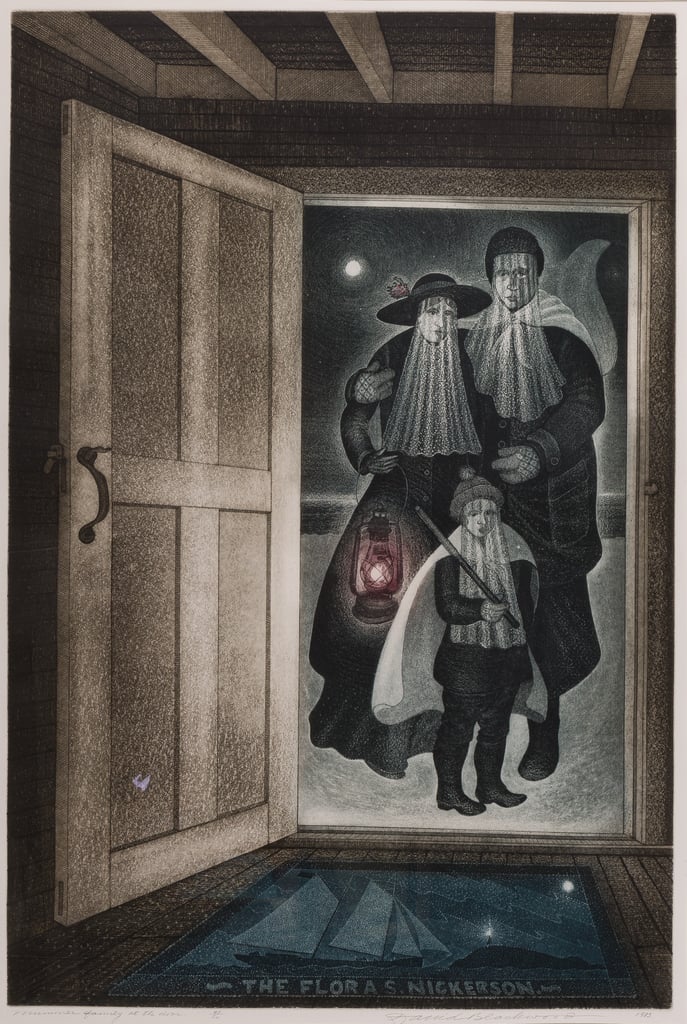
Mummer Family at the Door (1985) depicts the traditional Newfoundland custom of "mummering," where costumed participants visit houses during the Christmas season. The composition is viewed from inside a darkened home, looking out through an open doorway at three figures veiled in lace and heavy clothing. A central child carries a walking stick, while a woman holds a glowing lantern, providing the primary light source for the scene.
Technically, the work utilizes a combination of etching and aquatint to create deep tonal contrasts and intricate textures, particularly in the wood grain of the door and the stippled night sky. In the foreground, a hooked rug titled "The Flora S. Nickerson" sits on the floorboards, depicting a schooner at sea—a recurring motif in Blackwood's work that references his family's maritime heritage in Wesleyville. The print captures the specific atmosphere of this winter tradition, emphasizing the anonymity of the participants and the cultural significance of the ritual within a rural Newfoundland community.
David Blackwood
1941 - 2022 CM, RCA, O Ont
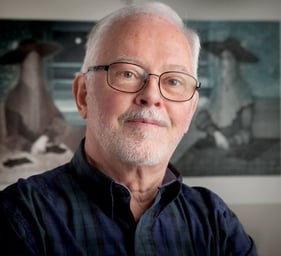
David Lloyd Blackwood was born in Wesleyville, Newfoundland, on November 7, 1941, to a family with a long seafaring history. Recognized for his artistic ability at an early age, he opened his first studio in 1956 at age fifteen. In 1959, he received a Government of Newfoundland Centennial Scholarship to study at the Ontario College of Art in Toronto, where he trained under instructors including John Alfsen, Carl Schaefer, William Roberts, Eric Freifeld, Rowley Murphy, and Jock MacDonald. After graduating in 1963, he moved to Port Hope, Ontario, where he became Art Master at Trinity College School, a part-time position that allowed him to continue his studio practice.
Blackwood's career advanced rapidly during the 1960s. By age twenty-three, the National Gallery of Canada had purchased one of his etchings. During this period, he developed one of the largest thematically linked series of prints in Canadian history, "The Lost Party," consisting of fifty etchings that depicted the Newfoundland sealing disaster of 1914. From 1969 to 1975, he served as the first Artist-in-Residence at Erindale College, University of Toronto, in Mississauga. In recognition of his contributions to establishing an art gallery there, the institution was named The Blackwood Gallery when it officially opened in 1992.
Throughout his career, Blackwood maintained his focus on Newfoundland subjects despite his Ontario residency. His work documented outport life, including the fisheries, seal hunting, resettlement, shipwrecks, and mummers. While best known for his stark blue-black etchings, he later experimented with watercolors and oil tempera. His artistic output was documented in four major publications: "The Wake of the Great Sealers" (1973), "The Art of David Blackwood" (1988), "David Blackwood: Master Printmaker" (2001), and "Black Ice: David Blackwood Prints of Newfoundland" (2011).
Blackwood's work received significant institutional recognition. He was a member of the Royal Canadian Academy of Arts and received honorary doctorates from Memorial University of Newfoundland and the University of Calgary in 1992. He was appointed to the Order of Canada in 1993 and the Order of Ontario in 2003. In 2003, he became Honorary Chairman of the Art Gallery of Ontario, the first practicing artist to hold this position. His work is held in major collections including the National Gallery of Canada, the Royal Collection at Windsor Castle, the National Gallery of Australia, the Uffizi in Florence, and the Montreal Museum of Fine Arts. The Art Gallery of Ontario created the Blackwood Research Centre in 2000 after acquiring a major collection of his prints. Blackwood died at his home in Port Hope on July 2, 2022, at age eighty.
More work by David Blackwood