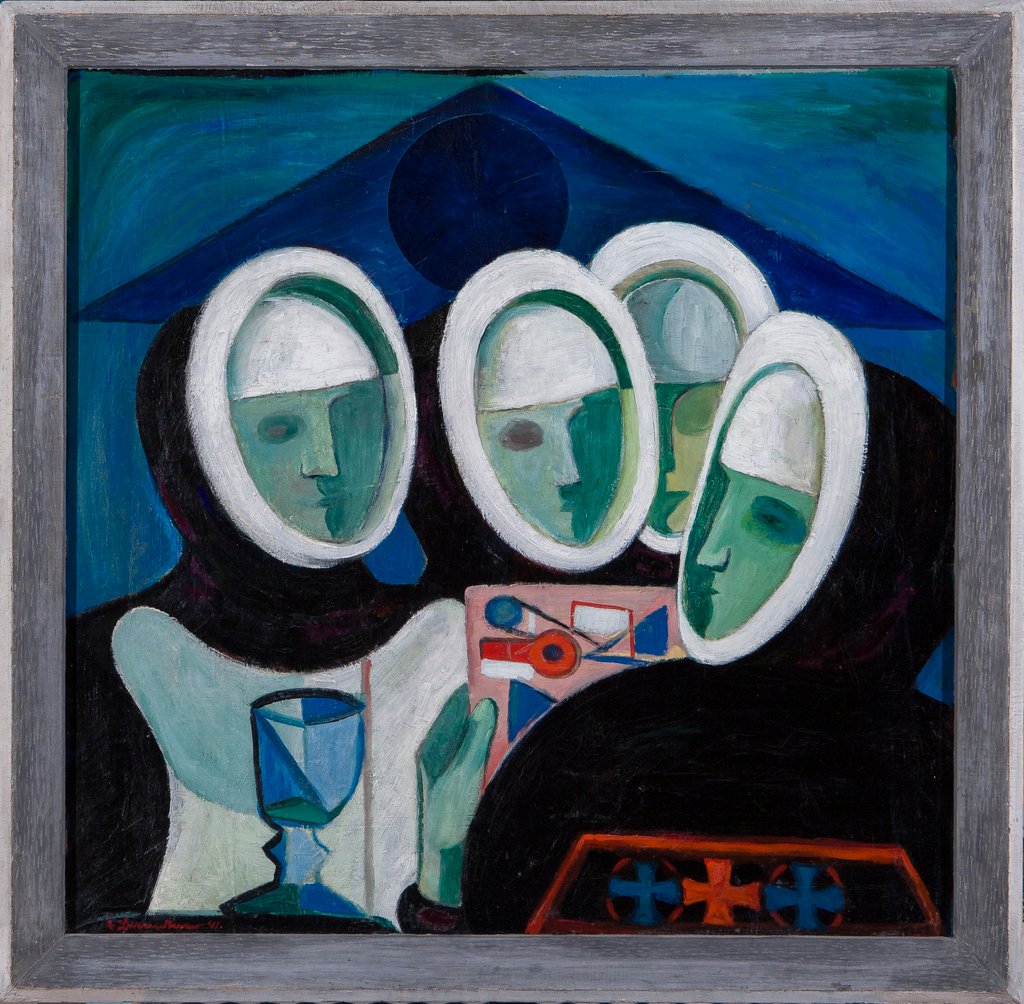
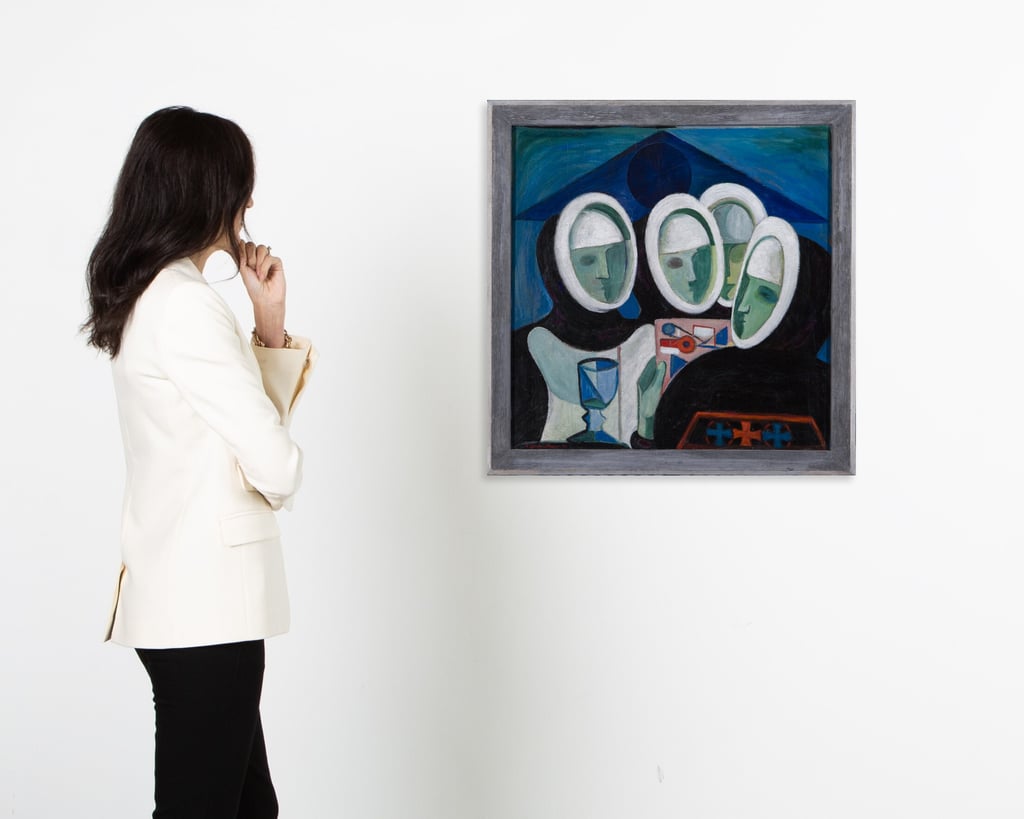
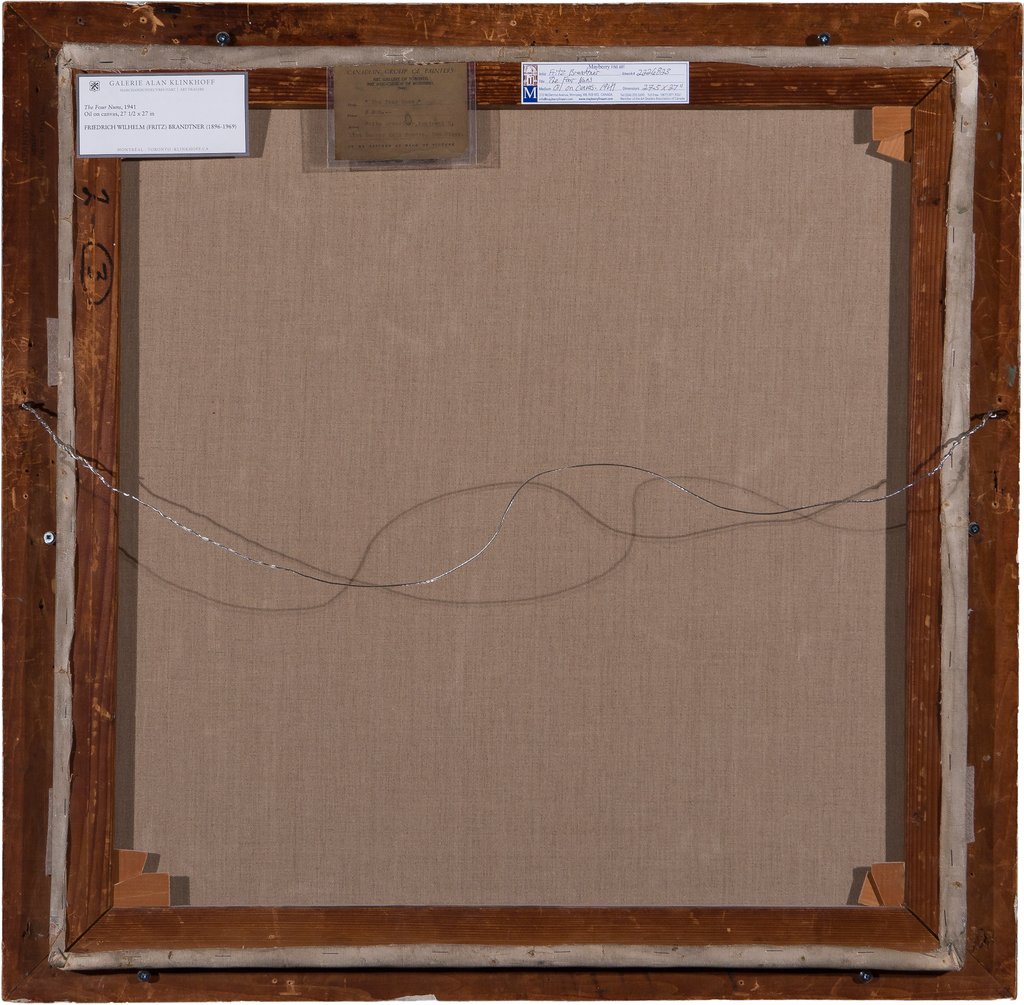
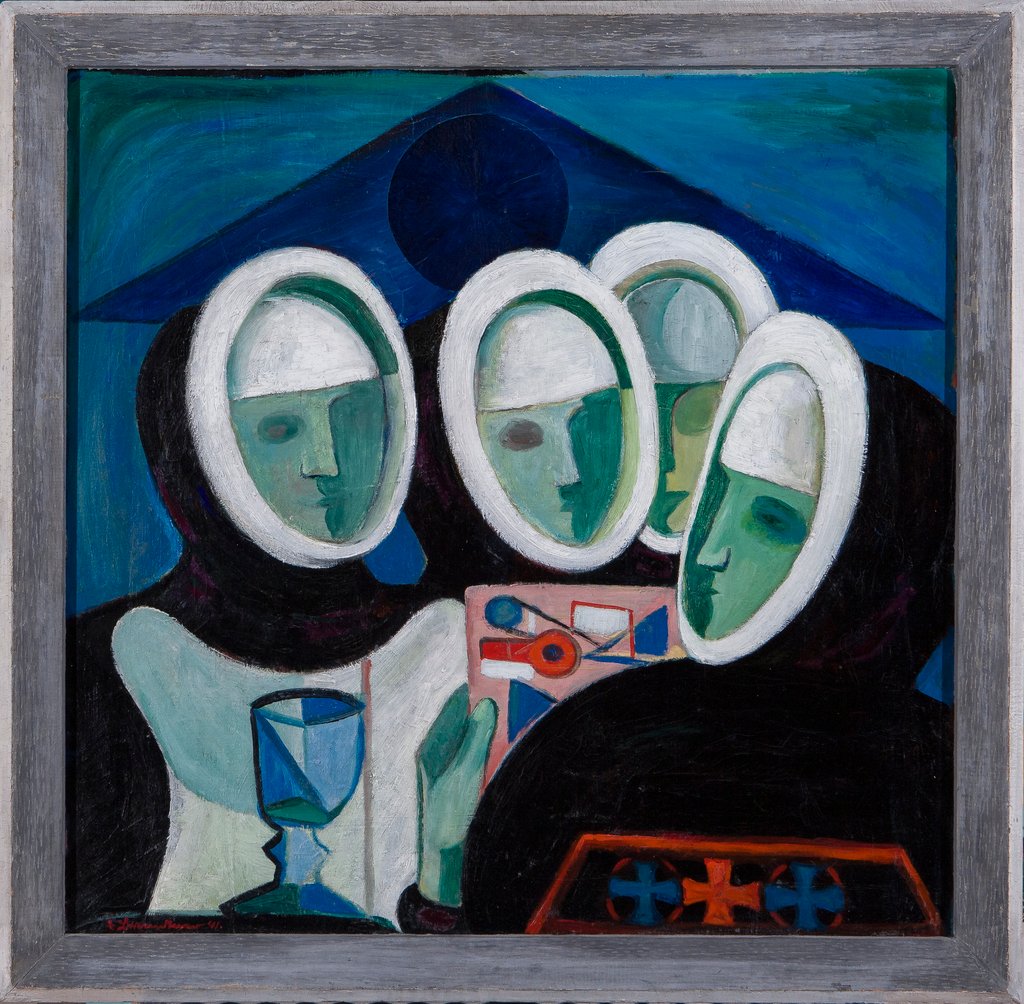
The Four Nuns
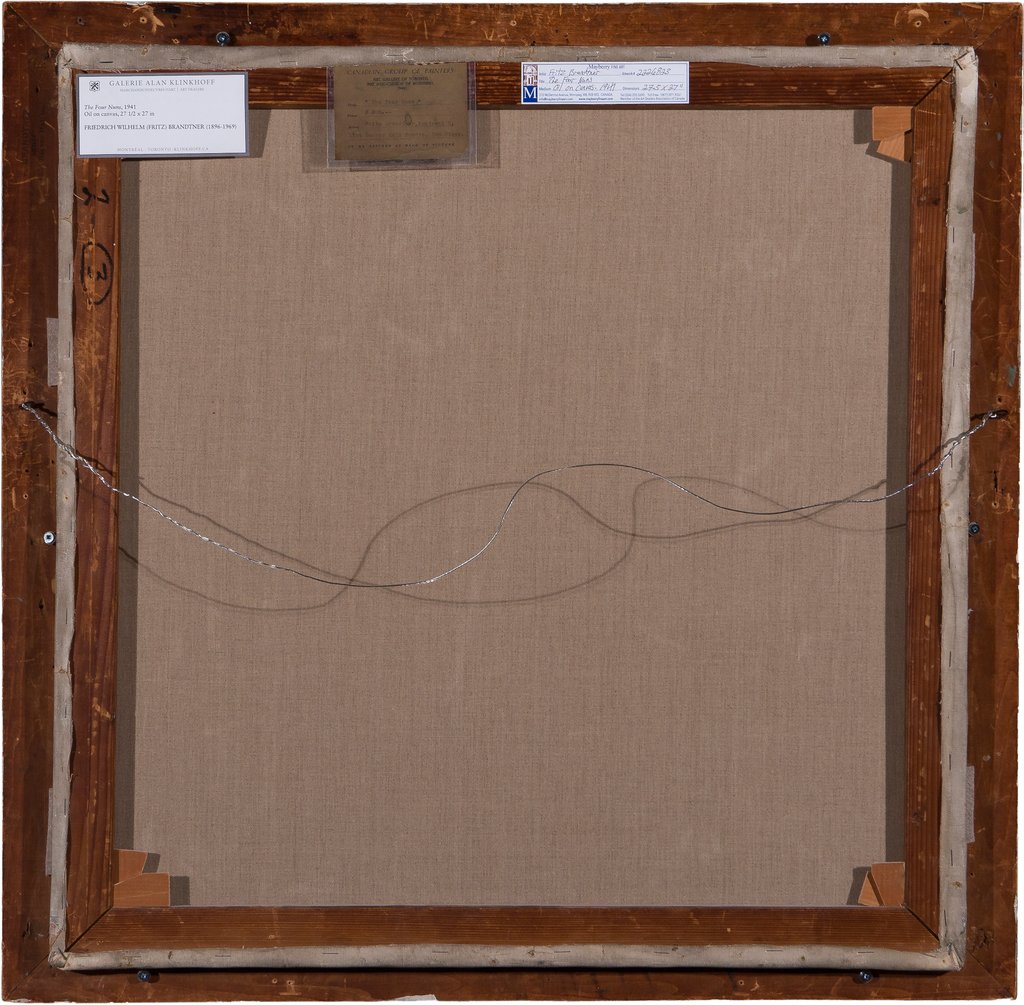
30 x 30.5 in (76.2 x 77.5 cm) including frame
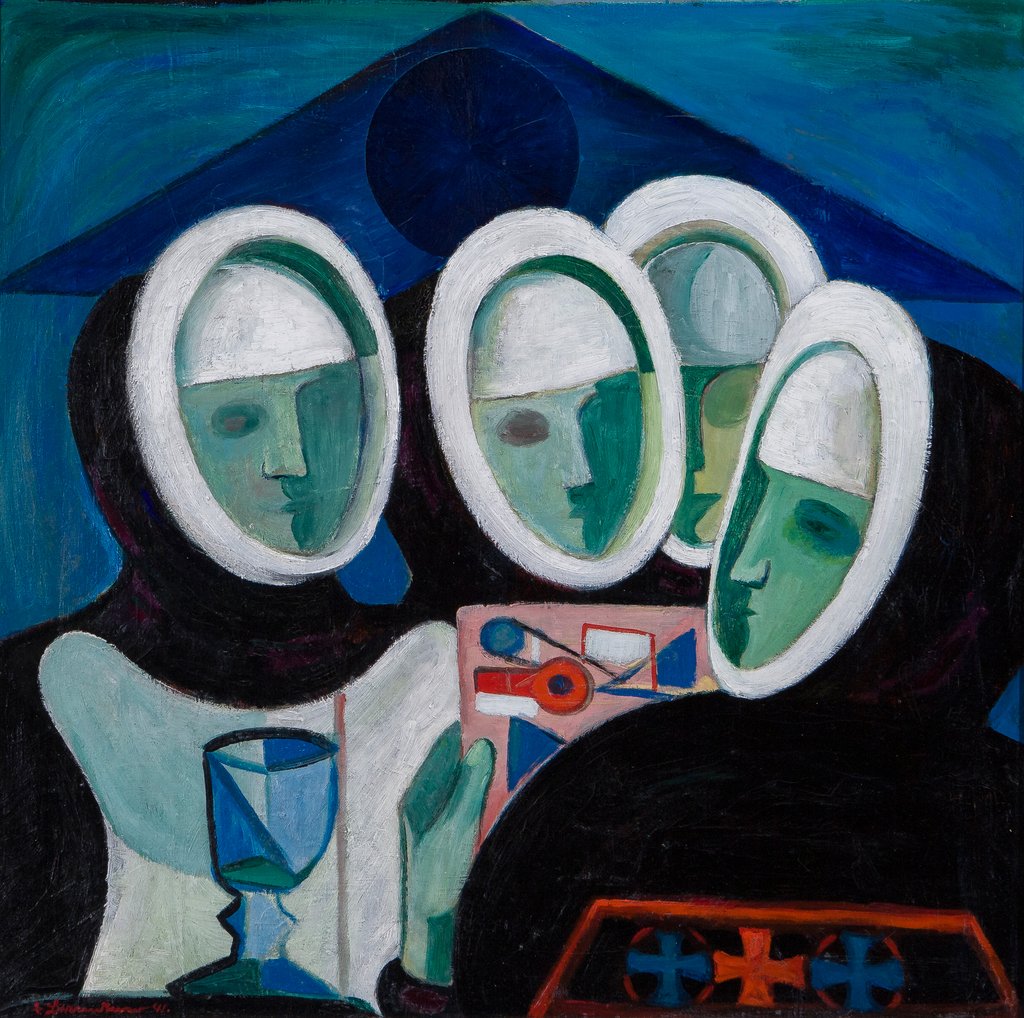
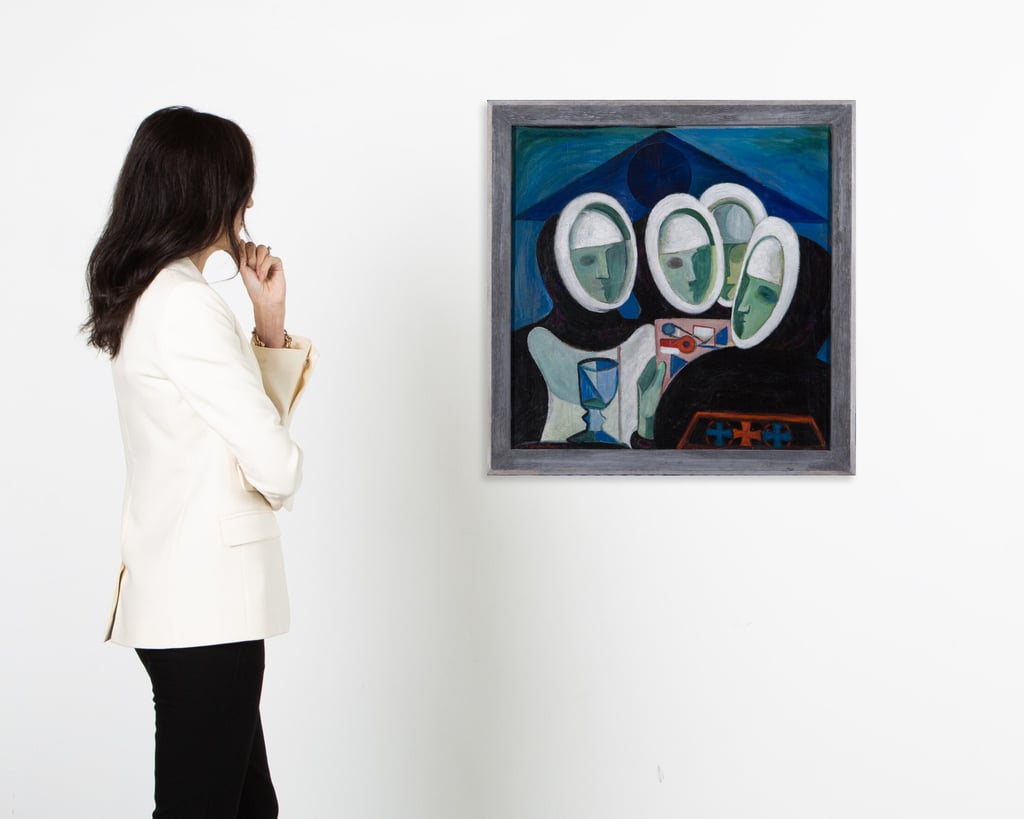
Fritz Brandtner’s arresting and beguiling work is enhanced by knowledge of its time and place, and this holds true for his 1941 painting The Four Nuns. Thirteen years earlier, in 1928, he emigrated from Germany, settled in Winnipeg, then moved to Montreal in 1934, and remained there for the rest of his life. His creativity, background, and engagement with central European modernism stood him apart from contemporary Canadian style and taste, yet respect from artists, collectors and critics has sustained interest in his art for nearly a century. In Montreal in 1936, Brandtner met Dr. Norman Bethune and became close friends. Unfortunately, Bethune’s early death while providing medical assistance in China during the Sino-Japanese War ended the life of a remarkable Canadian, an exceptional friendship, and his presence haunts The Four Nuns.
Brandtner’s 1936 ink drawing Dr Norman Bethune, Hospital du Sacre-Coeur, Cartierville (not offered with present lot) shows his friend operating, observed by nuns in a crowded clinic. Six years later this painting was shown in the Canadian Group of Painters exhibition that opened in Toronto in February 1942. In it, the drawing’s nuns have been reconfigured with the nun in bottom-right commanding attention and holding an abstract composition resembling Brandtner’s painted wooden constructions of the 1930s. The canvas’s synthesis of figures and Brandtner’s abstract constructions layer ambiguity upon mystery showing Brandtner at his best. His composition of bold colours with known and decontextualized images hearkens a metaphysical enigma of faith, mystery and reason that become richer with time.
Thank you to Gregory Humeniuk, independent art historian, consultant and curator, for contributing the preceding essay.
Fritz Brandtner
1896 - 1969 CGP, CSPWC, MSA
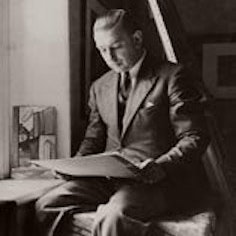
Friedrich Wilhelm Brandtner, known as Fritz Brandtner, was born on July 28, 1896, in Danzig, Germany (now Gdańsk, Poland). He was conscripted into the German Army in 1915 and served in World War I, spending months in the trenches of the Somme until being captured as a prisoner of war in France in 1916. He was held until his release in 1920. After the war, he returned to Danzig where he studied art and art history part-time at the University of Danzig, though he was largely self-taught. He became assistant to artist August Pfuhle, who introduced him to oil painting, drawing, and stained glass. From 1924 to 1926, Brandtner taught life drawing classes in the Architecture Department at the University of Danzig and worked as a commercial designer for advertising and display. During this period, he became greatly interested in the work of German Expressionists such as Kirchner and Kandinsky, whose works he studied at the Danzig Civic Gallery. He also viewed Canadian West Coast totem poles for the first time.
Recognizing limited opportunities in economically devastated Germany and sensing oncoming troubles, Brandtner emigrated to Canada in 1928, initially settling in Winnipeg. He worked as a house painter and did odd jobs before landing a position at Brigden's of Winnipeg Ltd. as a commercial artist and designer. Shortly after his arrival, he had his first Canadian exhibition at the Winnipeg School of Art, though it received mixed reviews. In Winnipeg, he met and became friends with Lionel LeMoine FitzGerald, principal of the Winnipeg School of Art, who encouraged him to exhibit his experimental paintings. Brandtner introduced FitzGerald to Modernism and the work of German Expressionists. He also met other Canadian artists including Caven Atkins, Bertram Brooker, Walter Phillips, and Philip Surrey.
Finding that his style of work was not well recognized in Winnipeg, Brandtner followed FitzGerald's advice to move to Montreal, a more cosmopolitan center with a more experimental art scene. Before leaving, the Winnipeg School of Art held a farewell exhibition of 150 of his works. He moved to Montreal in 1934 with an introduction from FitzGerald to Montreal art critic Robert Ayre, who in turn introduced him to the Montreal art community, including Louis Muhlstock, André Biéler, Jori Smith, John Lyman, and Anne Savage. Brandtner took work with Eaton's display department for two years.
Shortly after his arrival in Montreal, Brandtner exhibited in the Art Association of Montreal's Spring Group Exhibition, where his painting "Sunflower" was purchased by surgeon and collector Norman Bethune. Brandtner and Bethune discovered they shared similar social concerns, including the rise of Fascism, the potential for war, and poverty, especially among children. In February 1936, Brandtner held a solo exhibition at Henry Morgan and Co. department store, sponsored by the Canadian League Against War and Fascism, becoming the first artist to show staunchly abstract art in Montreal. Brandtner and Bethune were both members of this organization.
In 1936, Brandtner, together with Norman Bethune, George Holt, Elizabeth Frost, André Charles Biéler, and Hazen Sise, founded the Children's Art Centre in Beaver Hall Square, offering free art classes to children from low-income households. They expanded the program to include children with special needs at the Children's Memorial Hospital of Montreal. Along with Marian Dale Scott, who joined the teaching staff, Brandtner taught these classes. When Bethune left Montreal in October 1936 to participate in the Spanish Civil War, Brandtner moved into Bethune's Beaver Hall Square apartment.
Brandtner became a member of the Contemporary Arts Society of Montreal, serving as its first secretary from 1939 to 1957. He was vice-president of the Canadian Society of Painters in Water Colour from 1941 to 1943 and vice-president of the Canadian Group of Painters from 1944 to 1948. From 1949 to 1953, he served as director of the summer school at the Observatory Art Center at the University of New Brunswick in Fredericton, though he maintained his residence in Montreal. He continued to teach art classes and lecture in Quebec and Ottawa for the rest of his life.
Brandtner worked as a painter, printmaker, graphic artist, illustrator, muralist, and set designer. He worked in oils, watercolours, graphite, charcoal, mixed media, carved linoleum, and encaustic. His work was characterized by a strong sense of design, exuberant colors, and characteristic slashing black diagonals. He often worked in a limited palette of blacks, reds, and blues. His subjects included landscapes, cityscapes, portraits, still lifes, and anti-war imagery, with themes addressing workers, poverty, city life, and nature. His early influences derived from German Expressionists, and later from modernists of the semi-abstract and abstract movements. He painted European and German avant-garde influences combined with realism, creating works that showed traces of Picasso, the School of Paris, and surrealist accents, with later surges toward lyrical or geometric abstraction in the 1950s.
Brandtner was a prolific artist who participated in approximately fifteen solo exhibitions and numerous group exhibitions across Canada and internationally. His work was part of the painting event in the art competition at the 1948 Summer Olympics. In 1960, he was elected a life fellow of the International Institute of Arts and Letters. In 1968, he won the Canada Council Visual Arts Award for his works in encaustic. He also received the 1946 Jessie Dow Award from the Art Association of Montreal.
Brandtner died in Montreal on November 7, 1969. His close friend, Montreal art dealer Paul Kastel of the Kastel Gallery, was named executor of his estate and continued to promote Brandtner's work over the following four decades. The Fritz Brandtner library and art collection, including 172 items donated by Kastel in 2006, is part of the Library and Archives of the National Gallery of Canada. His work is represented in collections including the National Gallery of Canada, Art Gallery of Ontario, Musée national des beaux-arts du Québec, Vancouver Art Gallery, and numerous other institutions. He is recognized for introducing German Expressionism to Canada and playing a unique role as a bridge in the development of modern art in Canada.