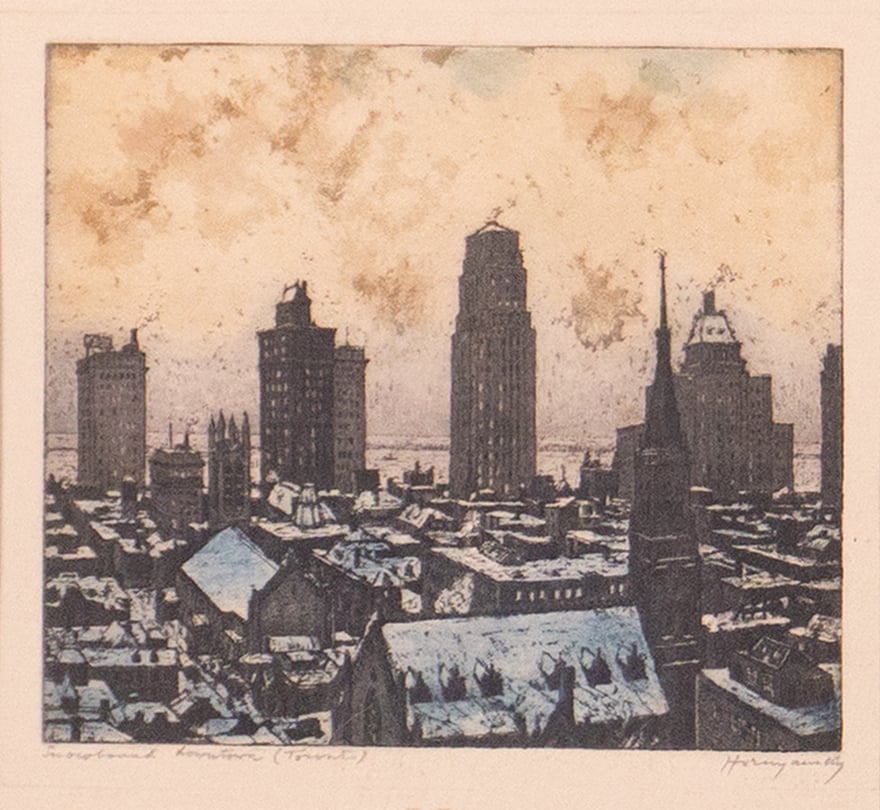
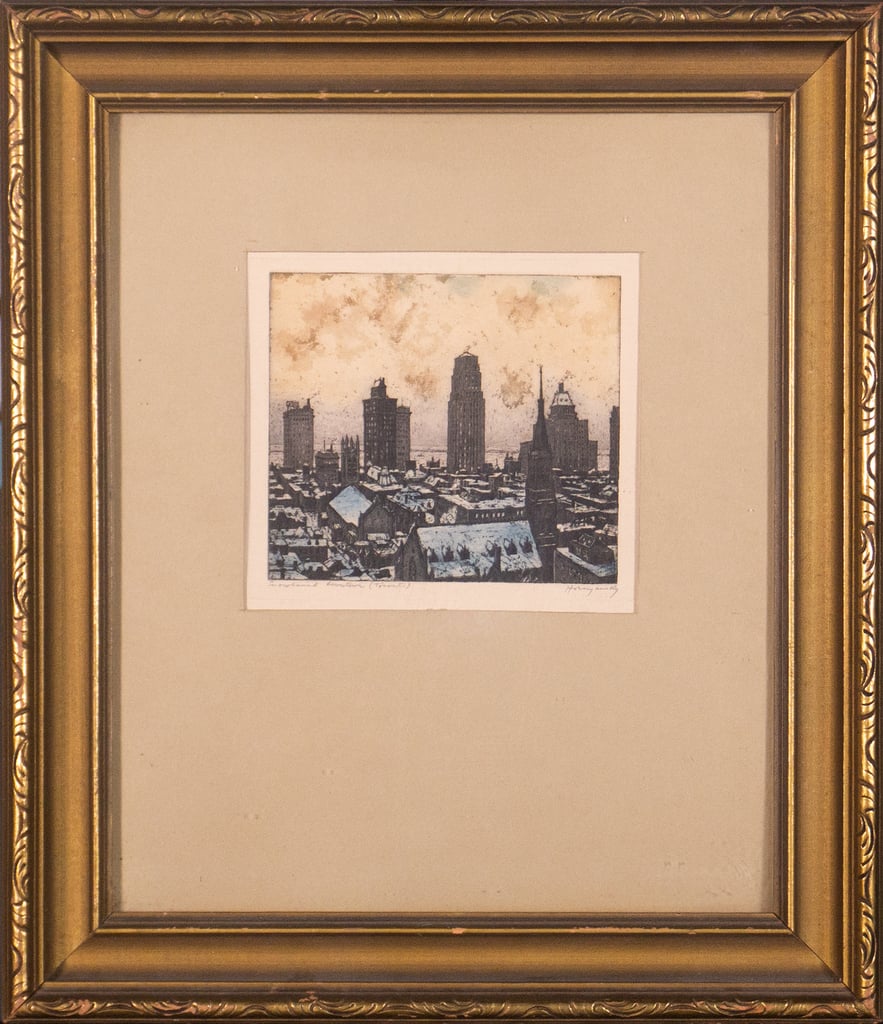
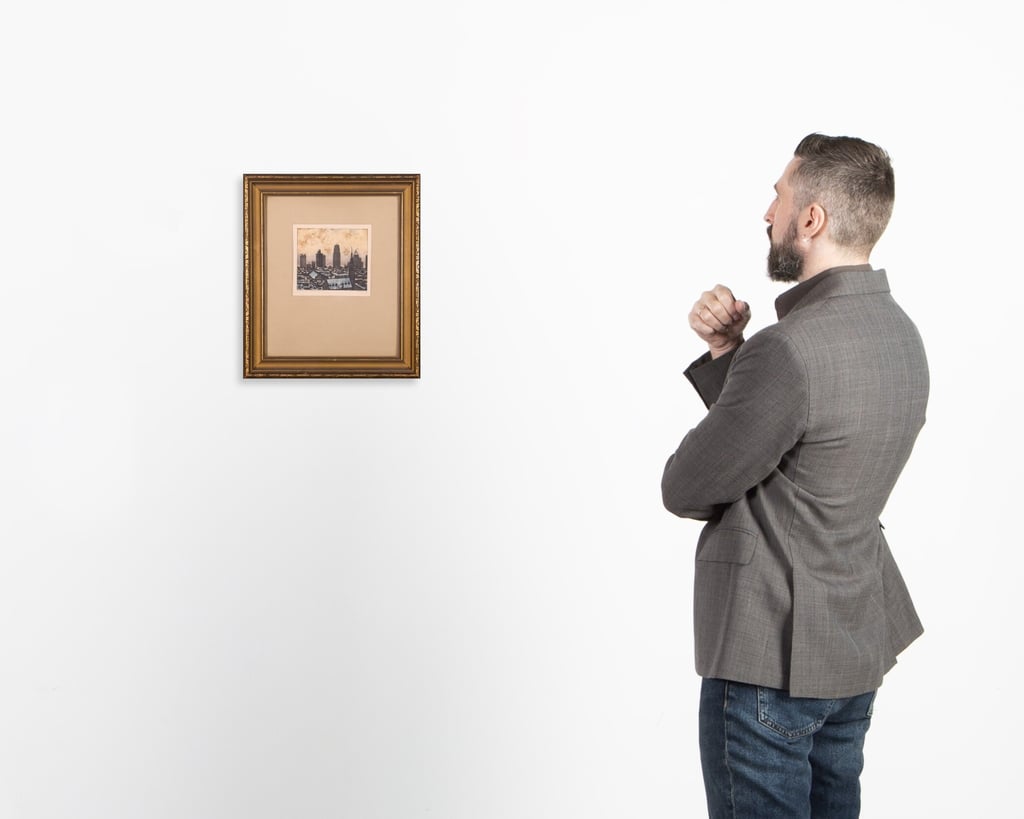
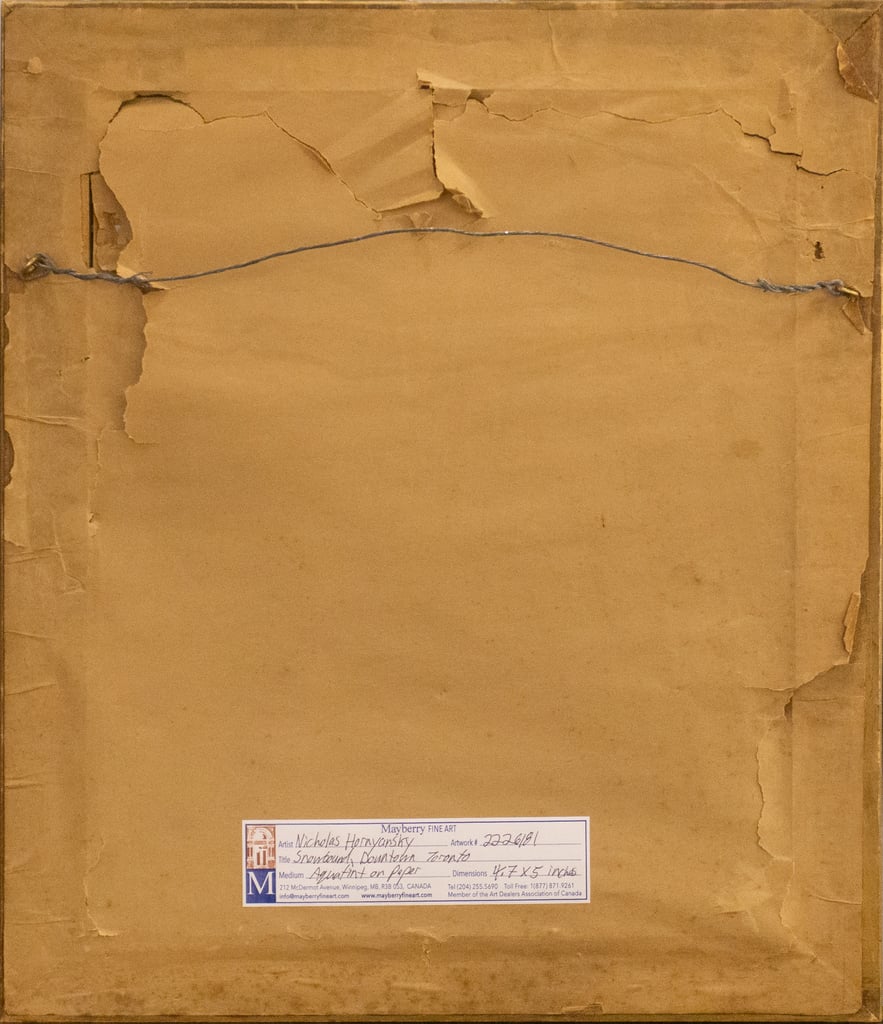
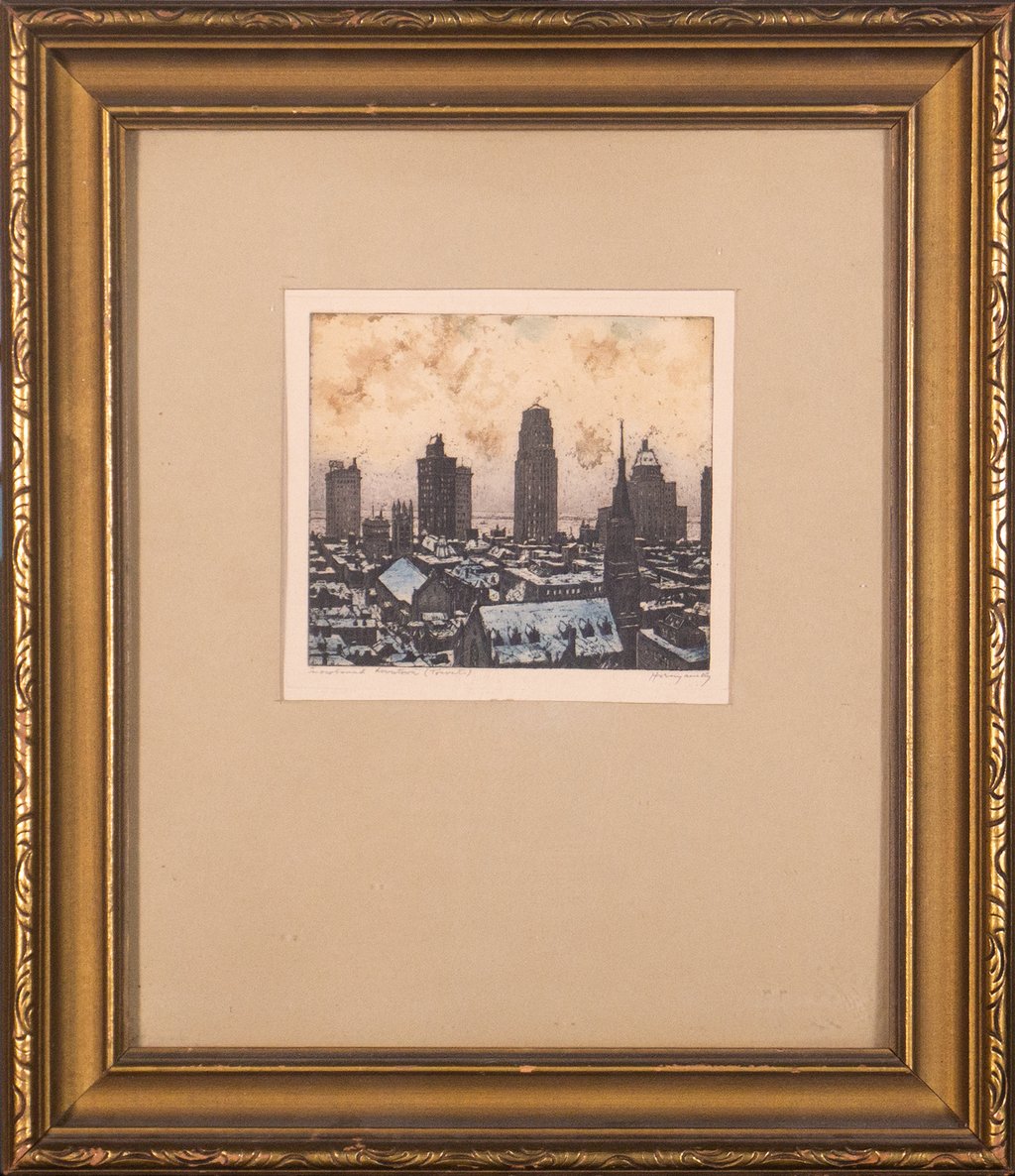
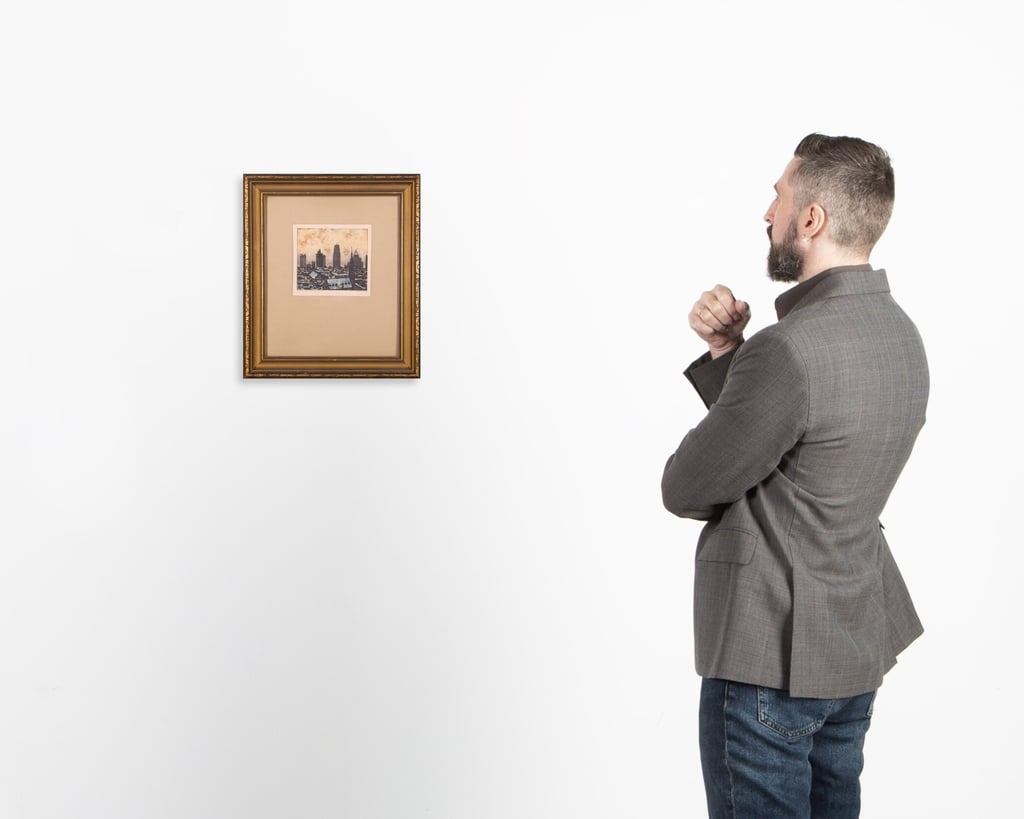
Snowbound, Downtown Toronto
15 x 13 in (38.1 x 33 cm) including frame
Nicholas Hornyansky
1896 - 1965 RCA
Nicholas Hornyansky was a Hungarian-born Canadian printmaker and painter who became a leading figure in the development of colour aquatint in Canada. Born in Budapest, he began working as a colour mixer in his father's printing office at the age of 12. He received formal training at the Academy of Fine Arts in Budapest under Professor Ballo and Professor Pasteiner. By age 16, he was already exhibiting at the Grand Salon of Budapest. Following his graduation, he pursued postgraduate studies in Vienna, Munich, Antwerp, and Paris, where he refined his skills in portraiture and landscape painting.
After spending nine years in Belgium and working with the School of Hens, Hornyansky travelled to England to fulfill several high-profile portrait commissions. He subsequently returned to Paris to study the complex technique of simultaneous colour aquatint printmaking under Sagnelonge and etching under Vilmos Aba-Novak. In 1929, he immigrated to Canada and settled in Toronto. He quickly established a reputation for his graphic works and figure paintings, notably his work titled The Ice-Man, which garnered significant critical attention.
Hornyansky is recognized as one of the most prominent aquatint artists in Canadian history. His practice involved extensive travels across the country, where he produced pencil and ink drawings that served as the foundation for his prints. His subject matter focused primarily on historic architecture, urban streetscapes, and Canadian landscapes, particularly in Ontario, Quebec, and the Maritimes. His work was noted for its vibrant colour palettes and technical precision, often merging European graphic traditions with Canadian imagery.
A dedicated educator and advocate for the arts, Hornyansky taught metal plate media at the Ontario College of Art from 1945 to 1958. He was a member of several major artistic organizations, including the Ontario Society of Artists and the Canadian Society of Graphic Art. He served as the president of the Society of Canadian Painter-Etchers and Engravers from 1943 to 1958, where he was instrumental in organizing national and international touring exhibitions to promote the medium of printmaking.
His contributions were recognized through numerous accolades, such as the International Award of "50 Colour Prints of the Year" from the American Federation of Artists in 1932 and 1933. In 1943, he was elected an Associate of the Royal Canadian Academy of Arts. His print Closing Time achieved historical significance as the first Canadian engraving to be included in the permanent collection of the Library of Congress in Washington, D.C.
Hornyansky's work is represented in many prestigious public institutions. His prints and paintings are held in the collections of the National Gallery of Canada, the Royal Ontario Museum, the Art Gallery of Ontario, and the Montreal Museum of Fine Arts. International collections featuring his work include the Metropolitan Museum of Art in New York, the Pennsylvania Museum of Art, and the Musée Plantin-Moretus in Antwerp.
More work by Nicholas Hornyansky