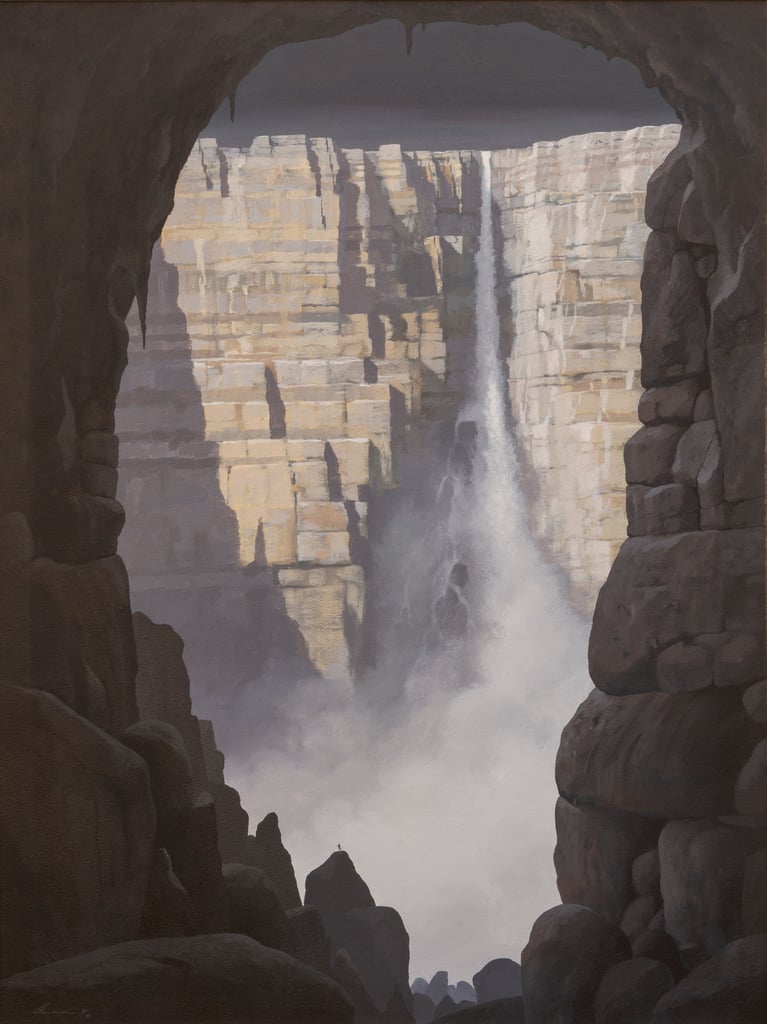
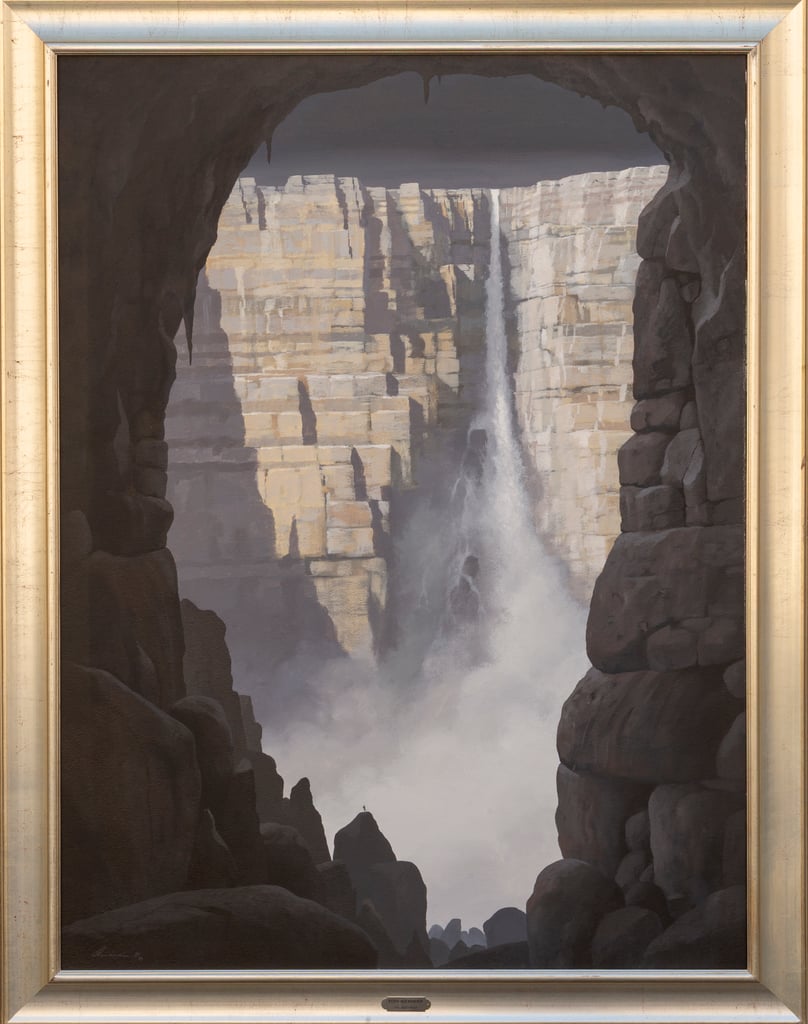

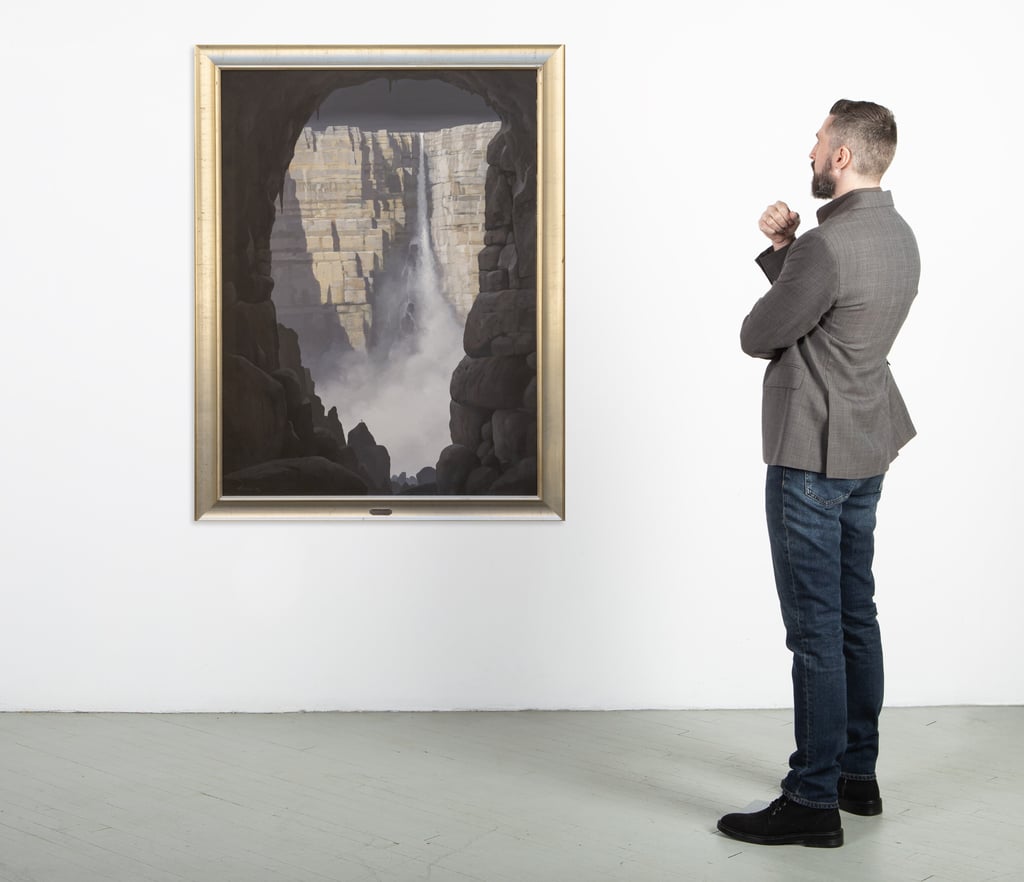
The Discovery
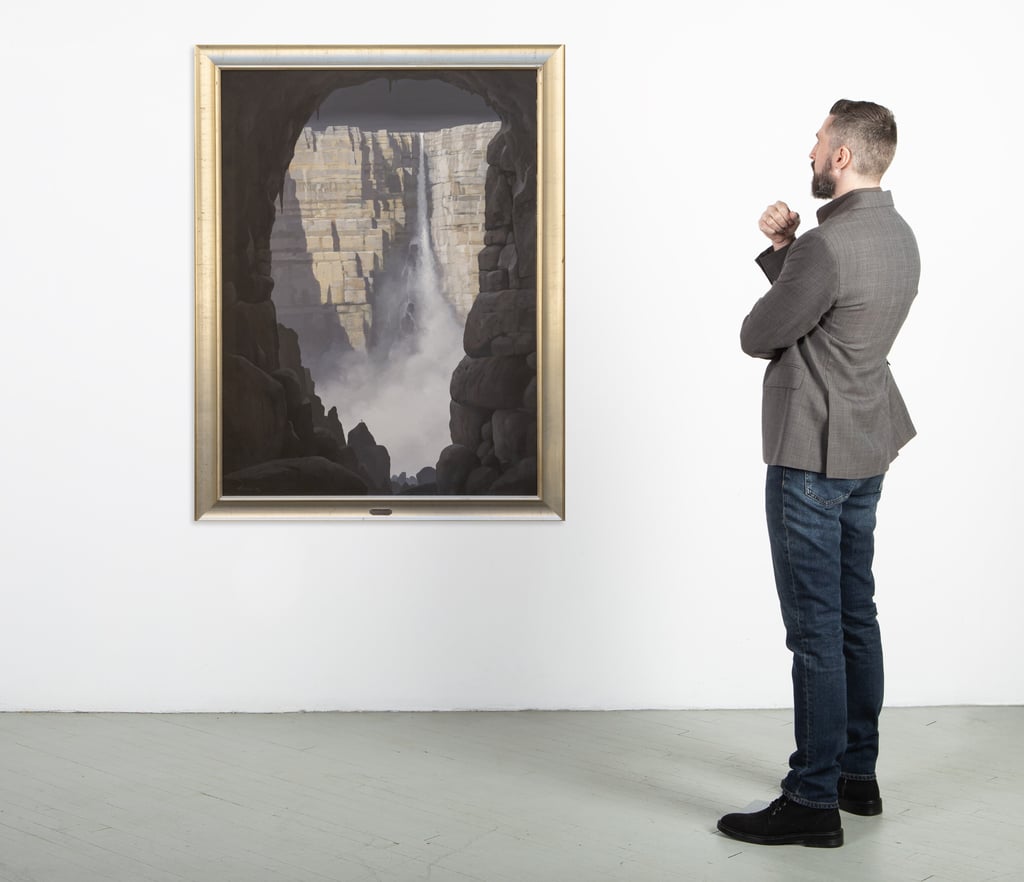
54 x 42 in (137.2 x 106.7 cm) including frame
Keith Alexander was a prominent South African artist whose work is characterized by a meticulous, "super-realist" technique often infused with surrealist undertones. The Discovery (1995) is a compelling example of his career-long fascination with the scale and silence of the African landscape, specifically the dramatic geology of the Namib Desert and the arid canyons of the subcontinent.
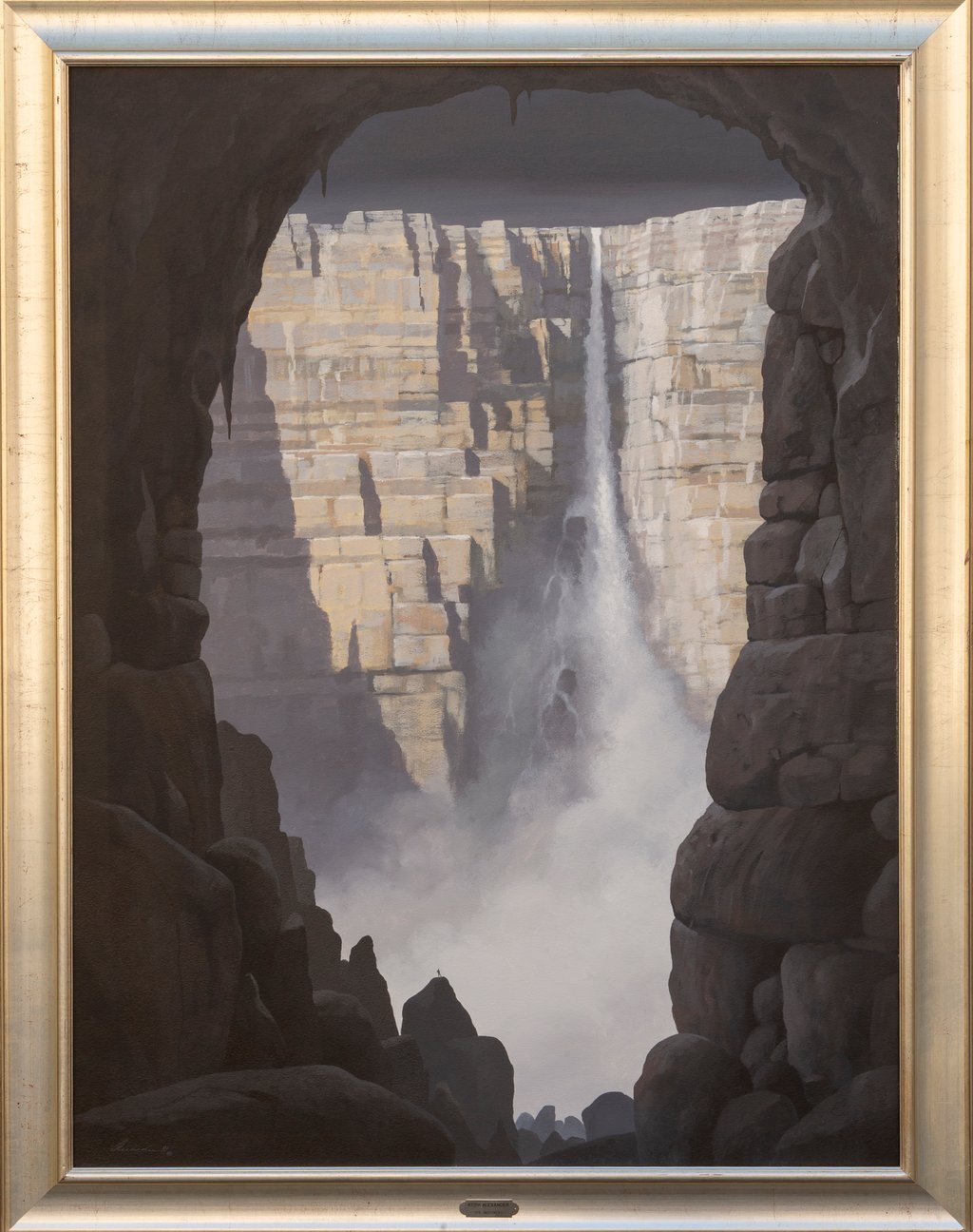
The composition is framed through the dark, arched silhouette of a cave mouth, creating a "painting within a painting" effect that emphasizes a sense of voyeurism and mystery. The viewer looks out onto a sun-drenched, towering rock face rendered with extraordinary architectural detail. A thin, powerful waterfall bisects the canyon wall, disappearing into a dense shroud of mist at the base. At the lower center of the work, a tiny human figure stands atop a jagged peak, providing a stark sense of scale and underlining the "discovery" referenced in the title.
Alexander’s work often explores the tension between the permanence of the natural world and the transitory nature of human presence. In this piece, the figure is dwarfed by the sheer magnitude of the stone and water, a recurring theme in Alexander’s oeuvre which frequently depicted decaying colonial architecture or solitary explorers reclaimed by the desert. Executed with the technical precision of a master of acrylics, The Discovery is a profound meditation on the sublime, capturing both the beauty and the indifferent power of the wilderness.

Keith Alexander
1946 - 1998
Keith Alexander (1946–1998) was a prominent South African artist recognized for his contribution to surrealist and photorealist painting. Born in Rhodesia, now Zimbabwe, he spent his formative years on his family farm before attending boarding school in London. His early exposure to the lingering physical damage of war in London and his later return to the politically fraught environment of southern Africa were significant factors that shaped his artistic perspective.
Alexander pursued his formal arts education at the University of Natal in South Africa, where he majored in sculpture. During his postgraduate studies, he explored the tenets of Surrealism, analyzing the works of artists such as Salvador Dalí, Joan Miró, Max Ernst, and René Magritte. Following his graduation, Alexander initially attempted to establish a career as a sculptor, but he found limited professional success in the medium.
In 1974, Alexander transitioned to painting, a shift he identified as a realization of his primary artistic aptitude. Throughout the 1970s and 1980s, he developed a distinct visual language defined by his use of oil on canvas. His work often incorporated themes of isolation and decay, frequently drawing inspiration from the stark landscapes of the Namib Desert, the ruins of colonial-era structures, and the skeleton coast of Namibia. His compositions utilized chiaroscuro lighting and intricate detail to convey a sense of surrealist drama.
His oeuvre, which includes over 500 documented paintings, serves as a record of his reaction to the political and social landscape of the time. Alexander continued to produce work until his passing in 1998. His life and career were the subject of the 1999 monograph Keith Alexander: The Artist in Retrospect, authored by David Robbins, which documents the development of his practice and his influence on contemporary South African art.