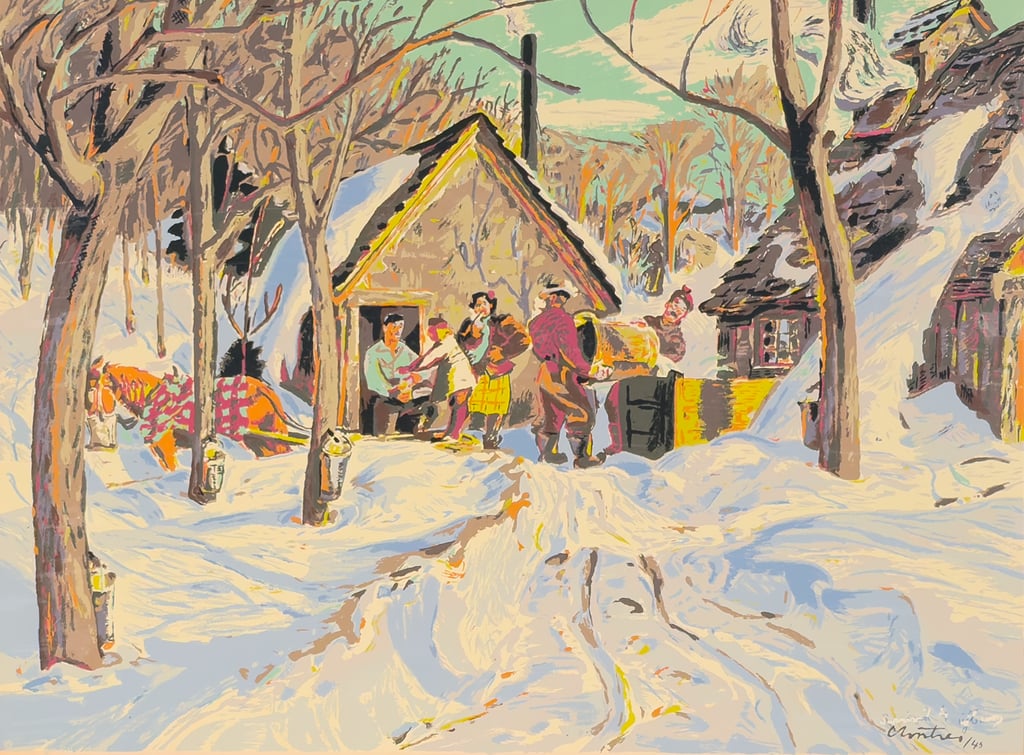
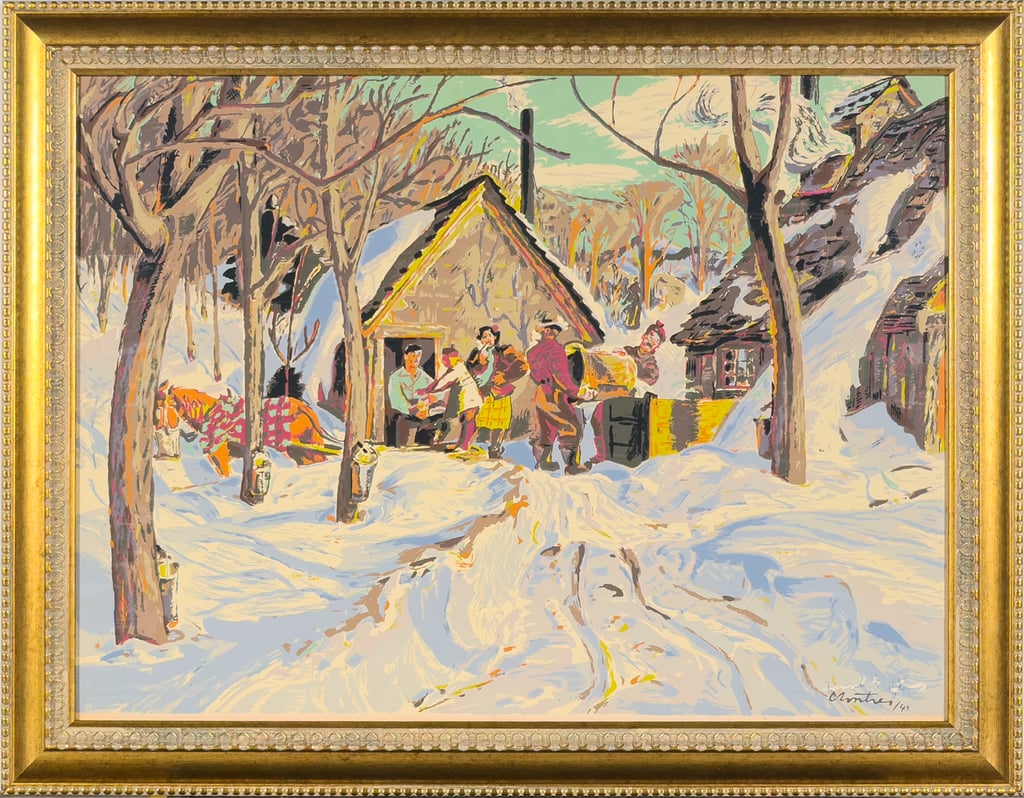
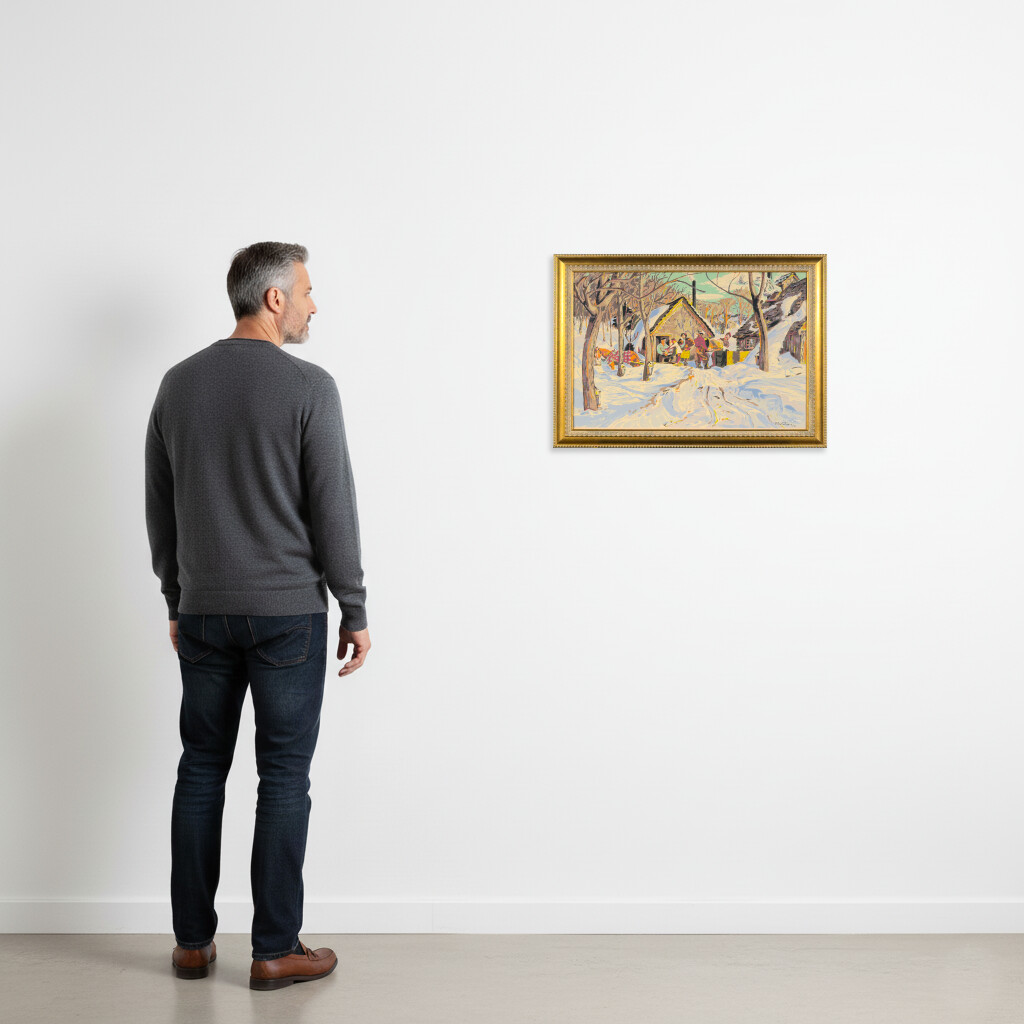
Sugar Time, Quebec
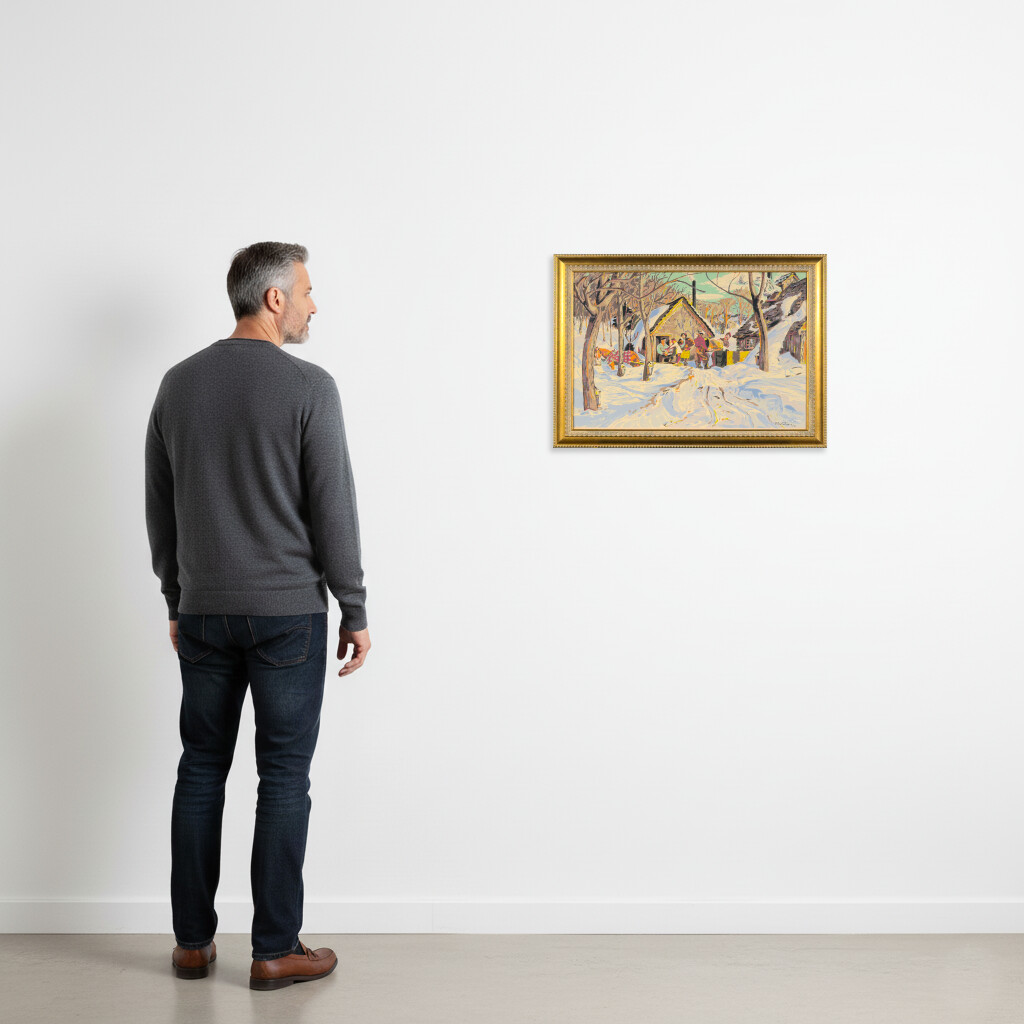
22 x 31 in (55.9 x 78.7 cm) including frame
This work was signed at a later date by A. J. Casson who was heavily involved in the Sampson-Matthews print making project. It contains his original signature.
The Sampson-Matthews print program was the largest public art project in Canadian history. Launched at the start of the Second World War, it lasted twenty-two years and cost tens of millions of dollars in today’s currency. At its height, it employed many of the country’s best commercial painters, designers and artists, working full-time to create masterpieces of serigraphy.
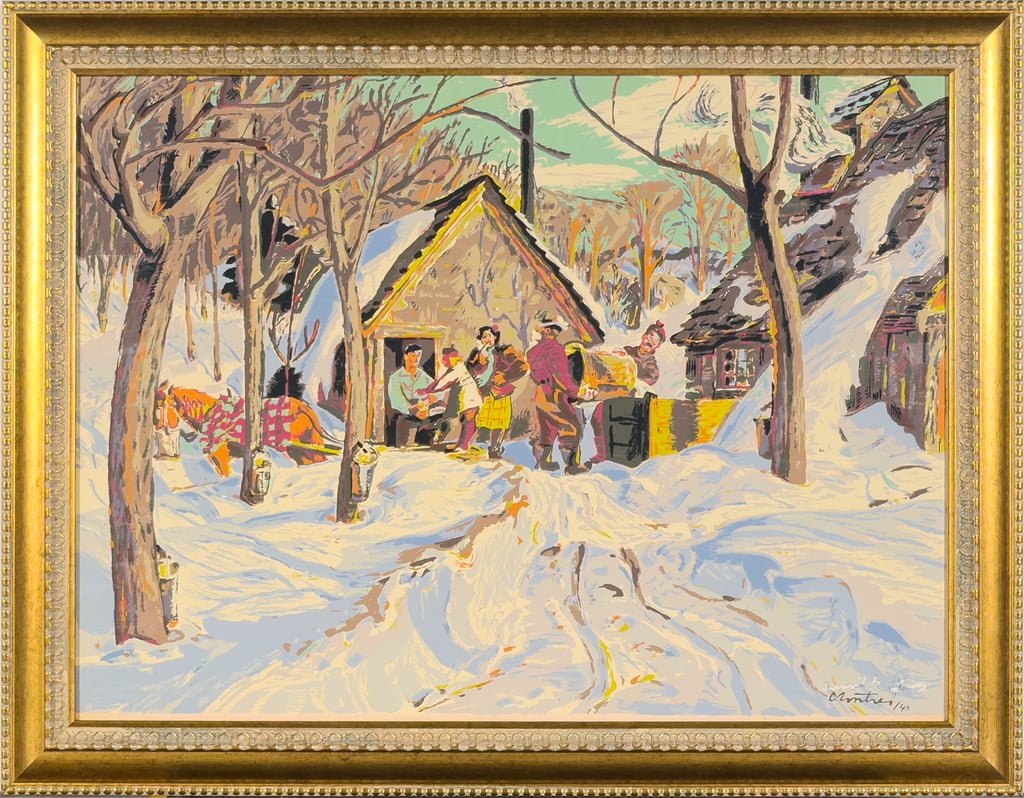
Albert Edward Cloutier
1902 - 1965 CSGA, CSPWC, FCA, RCA
Albert Edward Cloutier was born in 1902 to Canadian parents in Leominster, Massachusetts. The family moved back to Canada in 1903, and as a child, Cloutier received encouragement in the arts from his parents, beginning to paint at the Monument National at age eleven. Largely self-taught, he went on painting trips with A.Y. Jackson and Edwin Holgate, associations that would prove significant throughout his career. From 1918 to 1921, Cloutier worked as an apprentice with Smeaton Bros in Montreal, followed by positions with Associated Engravers in Montreal (1922-1925) and Batten Ltd. in Montreal (1926-1929). From 1929 to 1940, he worked as a freelance graphic designer and illustrator in Montreal while developing his fine art practice.
Cloutier was part of the "Oxford Group" led by painters André Biéler and Edwin Holgate, which met in a below-ground room at the Oxford tavern at lunchtime. The group maintained roughly equal numbers of francophone and anglophone members, including Adrien Hébert, art critic Jean Chauvin, and editor Carrier. His early work showed the influence of French Impressionists, the Group of Seven, and Paul Cézanne, while his later style evolved into an intensified realism with increasingly abstract and plastic forms. Working in oils, watercolours, tempera, clay, wood, metals, and mosaics, Cloutier followed the French Canadian tradition of depicting settled farm landscapes and Canadian beauty.
In 1939, Cloutier collaborated with Edwin Holgate on a 450-square-foot frieze for the Canadian pavilion at the New York World's Fair, commissioned by the Canadian government. The mural showed a panorama of the country's industries, people, and products, centered on a hydroelectric dam with a white horse representing power, with transmission lines leading to pulp and paper, mining, and manufacturing industries, and a man with horse and plough in the foreground representing traditional agriculture. During World War II, Cloutier served as Art Director for the Wartime Information Board in 1941, where he was instrumental in launching the Sampson-Matthews print program. In 1941, he and Eric Aldwinckle created a poster of Canada's New Army featuring clean lines and simple, efficient design. From 1943 to 1946, Cloutier served as an Official War Artist with the Royal Canadian Air Force, holding the rank of flight lieutenant. He was the only francophone war artist, and his pictures included training aircraft and flying boats.
After the war, Cloutier worked as a freelance graphic designer and illustrator in Ottawa from 1946 to 1948, then returned to Montreal in 1948, where he remained for the rest of his career. He lectured at the École des beaux-arts de Montréal for more than two years and made silkscreens for Sampson Matthews Limited. His major commissions included a mural for one of the new Park cars on the Canadian Pacific Railway's Canadian passenger train and illustrations for "Kingdom of the Saguenay" (1936) by Marius Barbeau. In 1958, he was among the artists selected to decorate the interior of the Queen Elizabeth Hotel, owned by the Canadian National Railway. He contributed carved wooden panels and painted twelve panels for the main dining room of the Salle Bonaventure covering subjects of music, handicrafts, and culinary arts. He also created a mural for Le Carignan restaurant at Place Ville Marie in Montreal, painting soldiers from the Carignan-Salières Regiment in full battle dress using dyes on fabric. In 1959, he designed and illustrated "Pathway to Greatness" for the Canadian Pulp & Paper Association, describing the development of the Saint Lawrence Seaway.
Cloutier became a member of the Federation of Canadian Artists in 1941 and the Canadian Society of Painters in Water Colour in 1948. He was elected an Associate of the Royal Canadian Academy of Arts in 1951 and became a full member in 1956. He joined the Arts Club of Montreal in 1951 and served as its president from 1957 to 1959. He also became a member of the Canadian Society of Graphic Art (circa 1952), served as president of the Art Directors' Club of Montreal (1953), and was a member of the National Society of Art Directors in New York City. His work is held by the National Gallery of Canada in Ottawa. Albert Cloutier died in Mont-Saint-Hilaire, Quebec, in 1965 at age 63.