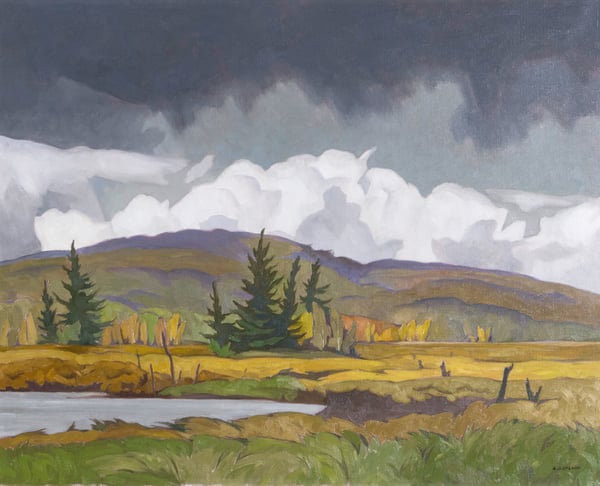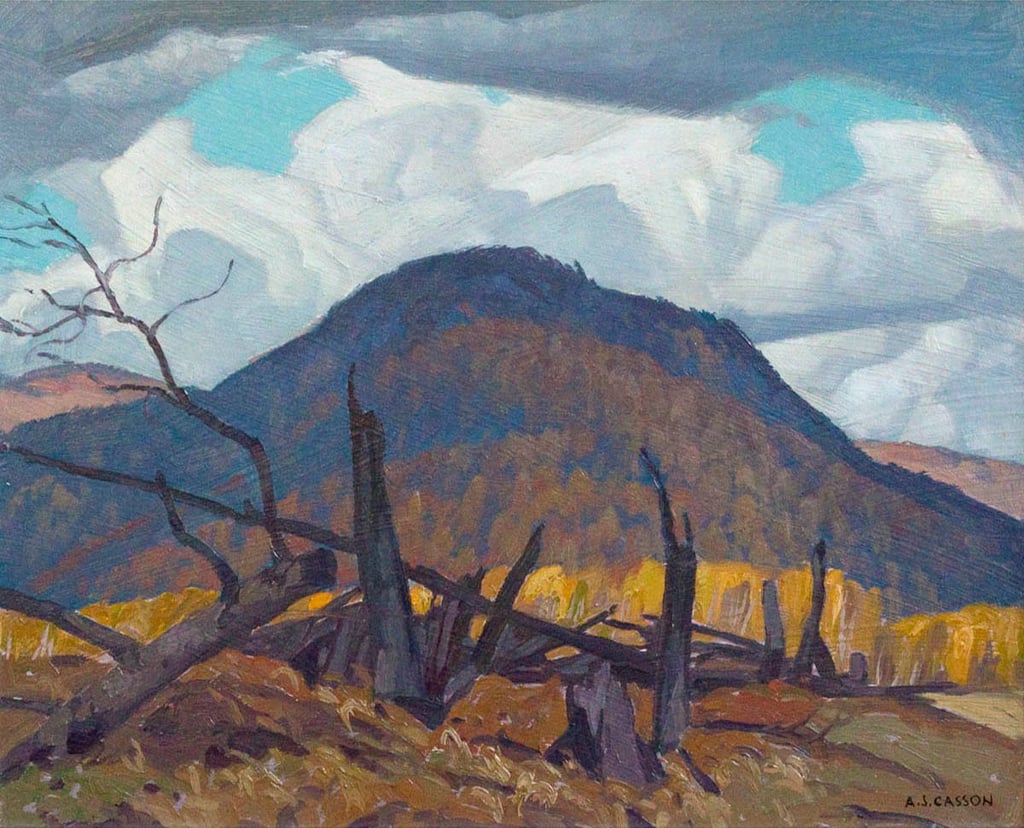
Halfway Lake
Sold
Alfred Joseph Casson
1898 - 1992 CGP, CSPWC, Group of Seven, OSA, PRCA
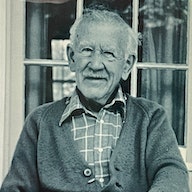
Alfred Joseph Casson was born on May 17, 1898, in Toronto, Ontario, to an English Quaker father and a Canadian mother. When he was nine, his family moved to Guelph, and later to Hamilton when he was fourteen. His first exposure to art came at Hamilton Technical School, where his teacher asked him to demonstrate for the class. At age fifteen, his father arranged for him to work as an apprentice at the Laidlaw Lithography Company in Hamilton, where he learned to retouch photographs, lay patterns, and engrave on zinc plates. He subsequently worked for Commercial Engravers Company in Hamilton before his family returned to Toronto in 1915, where he began working as a freelance designer while attending evening classes at Toronto Central Technical School under Alfred Howell and later at the Ontario College of Art under J.W. Beatty.
In 1919, Casson was employed by the firm of Rous & Mann Ltd. as assistant designer to Franklin Carmichael, beginning a seven-year apprenticeship that proved pivotal to his artistic development. Carmichael became not only his demanding but friendly boss, but also a mentor, friend, and sketching companion who introduced him to members of the Group of Seven at the Arts and Letters Club. Through Carmichael's influence, Casson developed higher standards in his work and moved toward a freer style using more color. During their early weekend trips, Carmichael helped Casson with color theory and subject selection, significantly shaping his artistic approach. In 1921, Casson made his first extended painting trip with Carmichael to Lake Rosseau in the Muskoka District and exhibited for the first time with the Ontario Society of Artists.
Casson's artistic career gained momentum in the mid-1920s. In 1923, his canvas "Clearing," based on a sketch from Lake Rosseau, was purchased by the National Gallery of Canada. In 1925, he joined with Carmichael and F.H. Brigden to form the Canadian Society of Painters in Water Colour, established to encourage and foster the art of watercolor in Canada. The following year marked two significant developments: he was invited to join the Group of Seven to replace Franz Johnston, who had left to pursue more commercially acceptable realistic scenes, and he began working for the firm of Sampson-Matthews, where he would spend most of his commercial career. Many of his large canvases were completed between 1926 and 1930 during sketching trips to the Haliburton region and Lake Superior areas.
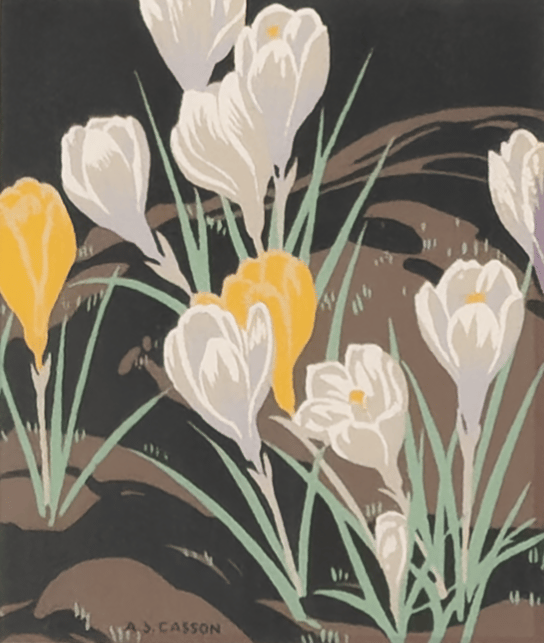
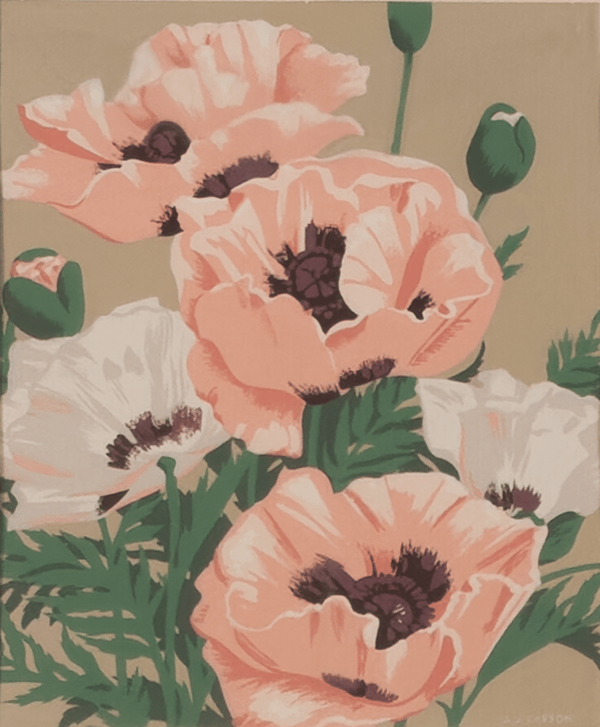
Beginning around 1924, Casson developed his distinctive focus on Ontario villages, deliberately seeking subject matter that distinguished his work from other Group of Seven members who concentrated on wilderness landscapes. He created numerous pencil and painted sketches of architectural details that became valuable references for larger oil studies, most notably his "Anglican Church at Magnetawan," completed in 1933 and purchased by the National Gallery of Canada in 1936. A fall while skating in 1924 aggravated a kidney stone, and his doctor advised him not to sketch outdoors for a year. During this restriction, he spent weekends painting flowers in the greenhouses of Allan Gardens, producing a series of small, glowing panels of flowers and still lifes that demonstrated his adaptability as an artist.
Casson's commercial career at Sampson-Matthews was as distinguished as his artistic practice. He served as Vice-President and Art Director for almost twenty years, becoming instrumental in the technical development of art reproduction programs carried out by the National Gallery of Canada, Canadian Pulp and Paper Association, and Sampson-Matthews Limited. His expertise in reproduction techniques led to his 1949 article "The Possibilities of Silk Screen Reproduction" in Canadian Art magazine. He supervised the production of approximately 100 different art prints from 1942 to 1963, including silkscreen reproductions of Canadian paintings designed to boost troop morale during World War II. Six of his own works were produced as silkscreens, including the popular "White Pine." He also created heraldic work reproduced by Sampson-Matthews, including armorial bearings for Canada and its provinces.
Throughout his career, Casson played a crucial role in organizing Canadian art institutions. Beyond co-founding the Canadian Society of Painters in Water Colour, he was instrumental in forming the Canadian Group of Painters in 1933 following the dissolution of the Group of Seven. He served as president of the Ontario Society of Artists from 1941 to 1945 and president of the Royal Canadian Academy of Arts from 1948 to 1952. His numerous honors included becoming a full member of the Royal Canadian Academy in 1940, receiving the Province of Ontario Award in 1948, and being appointed an Officer of the Order of Canada. He retired from commercial work in 1958 at age sixty to paint full-time, and also assisted the Anti-Rackets Branch of the Ontario Provincial Police in identifying forgeries of Tom Thomson and Group of Seven works. Casson died on February 20, 1992, just three months short of his 94th birthday, and was buried on the grounds of the McMichael Canadian Art Collection alongside six other Group of Seven members.
More work by Alfred Joseph Casson