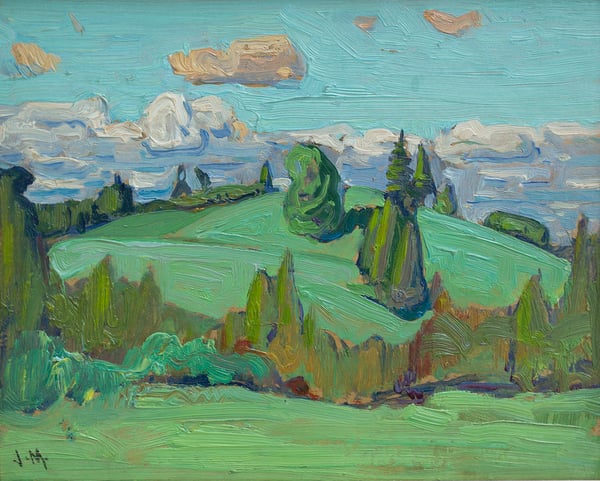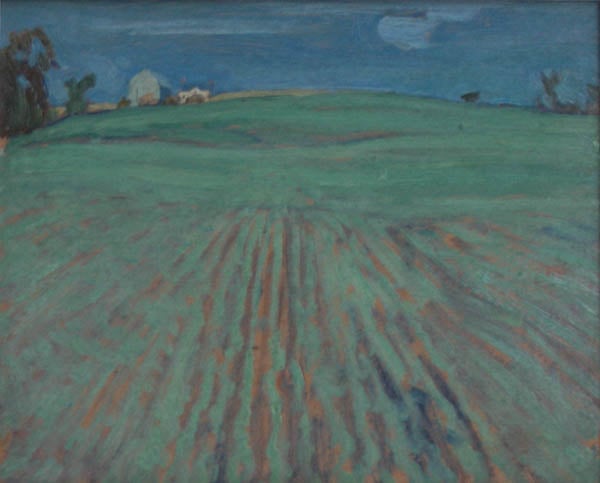
Near Thornhill
Sold
James Edward Hervey MacDonald
1873 - 1932 Group of Seven, RCA
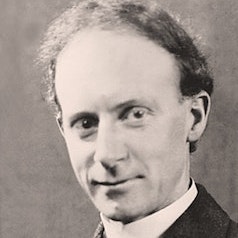
James Edward Hervey MacDonald was born on May 12, 1873, near Durham, England, to an English mother, Margaret Usher, and a Canadian father, William MacDonald, who was a cabinetmaker. In 1887, at age fourteen, he immigrated with his family to Hamilton, Ontario, where he began his first training as an artist at the Hamilton Art School, studying under John Ireland and Arthur Heming. In 1889, the family moved to Toronto, where MacDonald studied commercial art and became active in the Toronto Art Students' League, a society that believed in sketching outdoors. He continued his training at the Central Ontario School of Art and Design, studying with George Agnew Reid and William Cruikshank.
In 1894 or 1895, MacDonald took a position as a commercial designer at Grip Ltd., an important commercial art firm, where he further developed his design skills and, in the coming years, encouraged colleagues—including future artist Tom Thomson, who joined around 1907—to develop their skills as painters. In 1899, MacDonald married Joan Lavis, and two years later they had a son, Thoreau, named after the American writer Henry David Thoreau, one of MacDonald's favorite authors. MacDonald worked as a designer at Grip Ltd. until 1903, then at Carlton Studio in London from 1903 to 1907, and returned to Grip Ltd. in 1907. His design work was strongly influenced by Arts and Crafts designers in England and Canada, especially William Morris, and he became one of Canada's leading graphic designers and the greatest calligrapher of his period.
In 1911, MacDonald resigned his designer position at Grip Ltd. and moved with his wife and child to Thornhill, Ontario, to pursue a career as a landscape artist. To supplement his income, he worked occasionally as a freelance designer until 1921. After developing his own style as a painter, he organized a show of his work at the Arts and Letters Club of Toronto in November 1911. Fellow artist Lawren Harris, a member of the Royal Canadian Academy of Arts, was so impressed with MacDonald's work that he asked if they could work together. Harris encouraged MacDonald to continue painting and show his work whenever possible, and the following year they organized their first joint exhibition. In 1912, MacDonald was widely recognized for his contributions to an exhibition at the Ontario Society of Artists, and Harris later recalled that this show gave him his first recognition of what would become the Group of Seven's ethos.
In January 1913, MacDonald and Harris traveled to the Albright Art Gallery in Buffalo, New York, where they attended the Exhibition of Contemporary Scandinavian Art and saw post-Impressionist and expressionist landscape paintings by artists such as Gustaf Fjaestad and Vilhelm Hammershøi. The two artists felt that the approach to the northern Scandinavian wilderness could be adopted by Canadian painters to create a truly Canadian form of landscape art. Later that year, commercial artists based in Toronto began to congregate around MacDonald and Harris. In the spring of 1913, MacDonald wrote to A.Y. Jackson, inviting him to come to Toronto, which he did in May. In 1914, soon after the outbreak of the First World War, MacDonald created the poster "Canada and the Call" as a promotional piece for the Canadian Patriotic Fund, advertising an exhibition organized by the Royal Canadian Academy of Arts.
In March 1916, MacDonald exhibited "The Tangled Garden" at the Ontario Society of Artists. Though derided by critics of the day, it was a fairly conventional post-impressionistic painting of sunflowers based on sketches MacDonald made in his own garden at Thornhill. Accustomed to the smooth blending and muted tones of Canadian academic art in the style of the Canadian Art Club, critics were taken aback by the brightness and intensity of the colors. The Toronto Daily Star's art critic called it "an incoherent mass of color," and hostile art critics thereafter singled out MacDonald for attacks in the press. MacDonald was devastated by the accidental drowning of Tom Thomson in 1917 and designed a brass plaque to Thomson's memory, which was mounted on a cairn erected at Canoe Lake. After suffering a nervous breakdown in 1917, he also began writing poetry.
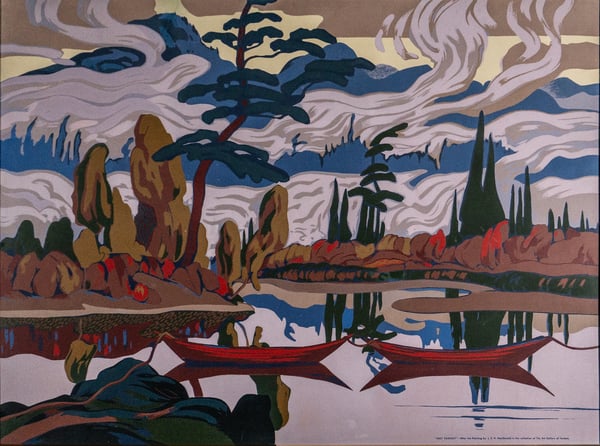
In the autumn of 1918, MacDonald, Harris, and other artists interested in their new Canadian approach to painting traveled to the Algoma district north of Lake Superior in a specially outfitted Algoma Central Railway car that functioned as a mobile artist studio. The group would hitch their car to trains traveling through the area, and when they found a scenic location, they would unhitch and spend time exploring and painting the wilderness. MacDonald would return to Algoma with his colleagues for the next several autumns through 1922. These trips produced some of his most acclaimed paintings, including "Mist Fantasy, Sand River, Algoma" (1920) and "The Solemn Land" (1921), elegant works that combined his longtime experience in design with fiery color. His palette was dark, tough, and rich, but his coloring was more fiery and his style more elegant than some of his contemporaries, with a sense of composition oriented toward his meditation on design.
In 1920, MacDonald co-founded the Group of Seven with Frederick Varley, A.Y. Jackson, Lawren Harris, Frank Johnston, Arthur Lismer, and Franklin Carmichael. The first official Group of Seven exhibition took place in May 1920. Beginning in 1924, MacDonald made the first of seven trips to the Canadian Rockies, traveling there every summer to paint the mountainous landscapes that dominated his later work. By this time he had become somewhat alienated from the rest of the Group of Seven, as many of the younger members were beginning to paint in a more abstract manner. MacDonald also painted decorations for Dr. James MacCallum's cottage in Georgian Bay (1915) and St. Anne's Church in Toronto (1923).
From 1921, MacDonald taught at the Ontario College of Art, and from 1928 until his death served as its Principal, a position he assumed in 1929. His teaching responsibilities sapped his energies, and he painted with less frequency and did few large canvases during this time. MacDonald suffered a stroke in November 1931 and spent the following summer in Barbados with his wife to recover. He died in Toronto on November 26, 1932, at age fifty-nine, and was buried at Prospect Cemetery in Toronto. His former home and four-acre garden in Vaughan, Ontario, have been restored and are owned by the City of Vaughan, open to the public. MacDonald is remembered as a founding member of the Group of Seven who profoundly shaped Canadian landscape painting, with one writer commenting that "no Canadian landscape painter possessed a richer command of colour and pigment than J.E.H. MacDonald."
More work by James Edward Hervey MacDonald