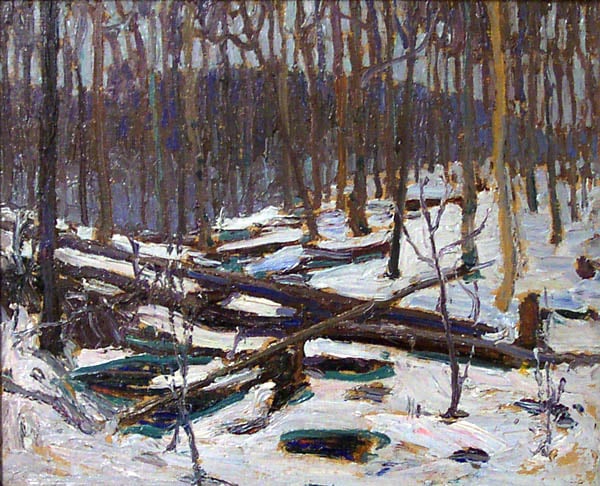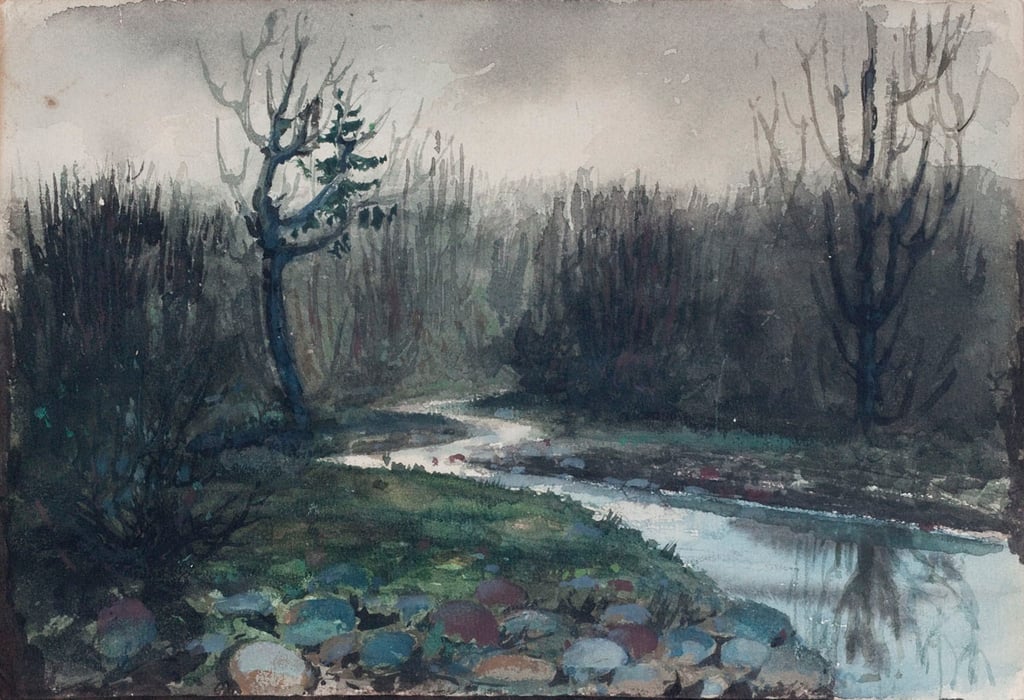
Stream in a Marsh
Sold
Tom Thomson
1877 - 1917 Group of Seven
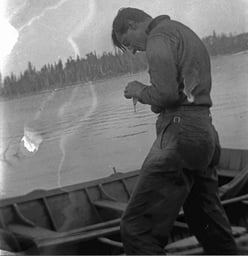
Thomas John Thomson (1877-1917) was a Canadian painter whose depictions of the northern Ontario wilderness became iconic representations of the Canadian landscape and a defining influence on Canadian art. Born on August 5, 1877, in Claremont, Ontario, he was the sixth of ten children born to John and Margaret Thomson. The family moved to a farm near Leith, outside Owen Sound, where Thomson was raised in a creative household that encouraged drawing, painting, and music. His father was something of a naturalist, and Thomson's older cousin, Dr. William Brodie, was a prominent naturalist who served as director of the Biological Department at what is now the Royal Ontario Museum. Thomson collected specimens with Dr. Brodie, learning to combine keen observation of nature with reverence for its mystery. He was taken out of school for a year due to chronic illness, including respiratory problems, which gave him extensive time to explore the woods near his home and develop his deep appreciation for nature.
Thomson initially showed no exceptional artistic talent and worked various jobs including at an iron foundry and machine shop in Owen Sound. In 1901, he enrolled at Canada Business College in Chatham, Ontario, where he developed skills in penmanship and copperplate writing. After graduation, he briefly traveled to Winnipeg before joining his brother George in Seattle in January 1902, where George and cousin F.R. McLaren had established the Acme Business College. Thomson worked as a pen artist, draftsman, and etcher at Maring & Ladd, and later at Seattle Engraving Company, specializing in lettering, drawing, and commercial design. His time in Seattle ended abruptly, possibly due to a rejected marriage proposal to Alice Elinor Lambert, and he returned to Ontario in 1905.
Settling in Toronto in the summer of 1905, Thomson began his transformation from commercial artist to painter. He initially worked at the photo-engraving firm Legg Brothers before joining Grip Ltd. in 1908 or 1909, the leading graphic design company in Canada. At Grip, he met the future members of the Group of Seven, including J.E.H. MacDonald, who became his mentor and encouraged him to paint outdoors to develop his skills. Through MacDonald, Thomson was introduced to Lawren Harris at the Arts and Letters Club, considered the center of Toronto's artistic community. He later moved to Rous & Mann Press Limited in 1912, following his colleagues from Grip.
Thomson's painting career began in earnest in May 1912 when he first visited Algonquin Park on a canoe trip with colleague H.B. Jackson. It was during this trip that he acquired his first sketching equipment and began capturing nature scenes, though he initially did not take his painting seriously. His exposure to the northern wilderness proved transformative, and he returned repeatedly to Algonquin Park, typically spending springs and summers there and winters in Toronto. In October 1912, MacDonald introduced him to Dr. James MacCallum, an ophthalmologist and art patron who recognized Thomson's talent. In 1913, MacCallum offered to financially support both Thomson and A.Y. Jackson for one year if they committed to painting full-time, an offer Thomson accepted despite his initial reluctance and fear of becoming "an object of patronage."
Thomson's artistic development was rapid and remarkable. He first exhibited with the Ontario Society of Artists in March 1913, selling his painting "Northern Lake" to the Ontario Government for $250, which provided him financial freedom to continue painting. He shared studio space at the Studio Building in Toronto, first with A.Y. Jackson and later with Franklin Carmichael, before moving to a small shack behind the building that Harris and MacCallum fixed up for him. His working method involved creating oil sketches directly from nature on small wood panels, then developing selected sketches into larger studio canvases during the winter months. His technique evolved from initially "dark, muddy" paintings to works characterized by vivid colors, bold brushstrokes, and thick application of paint.
Thomson's mature period produced his most celebrated works, including "The Jack Pine" and "The West Wind," both painted in 1916-1917. These paintings exemplified his distinctive style that combined direct observation of nature with stylized design elements influenced by Art Nouveau and Post-Impressionism. His approach to landscape painting became increasingly imagination-based by 1915, often seeking natural features that corresponded to pre-existing artistic ideas or painting from memory in his Toronto studio. His commercial design background permeated his late canvases, which featured stylized tree branches and flat areas of strong color that created musical rhythms and patterns in his compositions.
Thomson's career was tragically cut short when he disappeared on July 8, 1917, during a canoeing trip on Canoe Lake in Algonquin Park. His upturned canoe was found that afternoon, and his body was discovered eight days later with a four-inch cut on his right temple and bleeding from his right ear. The cause of death was officially ruled "accidental drowning," though the circumstances have generated persistent speculation about murder or suicide, theories that lack substantive evidence. He was initially buried in Mowat Cemetery near Canoe Lake but was exhumed two days later and reinterred in the family plot beside Leith Presbyterian Church. In September 1917, J.E.H. MacDonald and John William Beatty erected a memorial cairn at Hayhurst Point on Canoe Lake.
Thomson's legacy has grown immensely since his death, with his works becoming icons of Canadian culture and national identity. Though he died before the formal establishment of the Group of Seven, he is considered an unofficial member and primary influence on the group's development. During his short professional career, he produced approximately 400 oil sketches and 50 larger canvas works. The Tom Thomson Art Gallery opened in Owen Sound in 1967, and his studio shack was moved to the McMichael Canadian Art Collection in Kleinburg in 1968. His works are held in major Canadian collections including the National Gallery of Canada, Art Gallery of Ontario, and McMichael Canadian Art Collection. The increased value of his work over time has led to numerous forgeries appearing on the market, with his sketch "Early Spring, Canoe Lake" selling for CAD$2,749,500 in 2009. His influence on Canadian art extends far beyond his lifetime, with later artists considering him the embodiment of Canadian artistic identity and "the manifestation of the Canadian character."