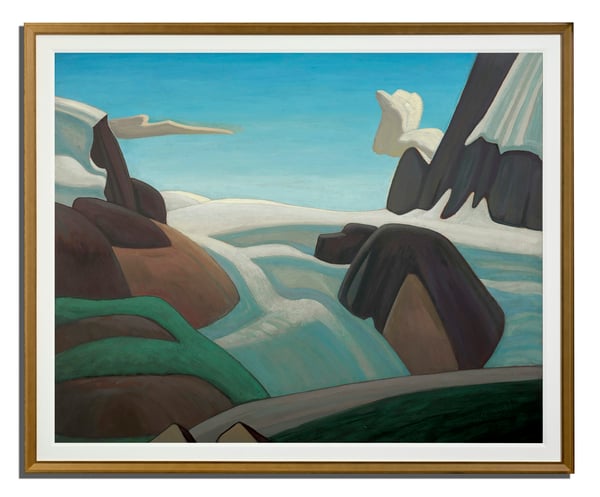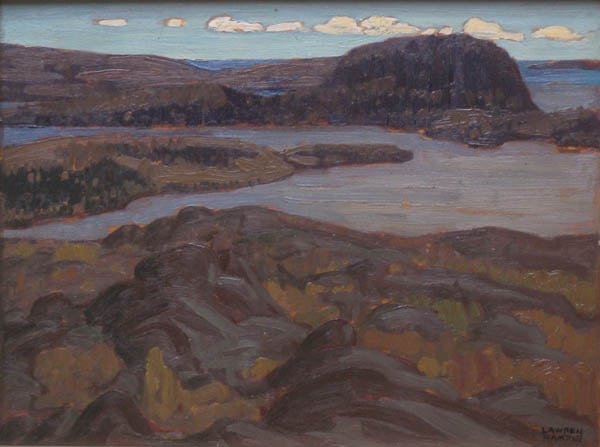
From the North Shore, Lake Superior
Sold
Lawren Harris
1885 - 1970 CGP, Group of Seven, Order of Canada, RCA
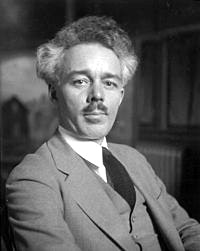
Lawren Stewart Harris was born on October 23, 1885, in Brantford, Ontario. He was the son of Thomas Morgan Harris, secretary to the firm of A. Harris, Sons & Company Ltd., merchants of farm machinery, which merged with the Massey firm in 1891, forming the Massey-Harris Company, later known as Massey Ferguson. Harris's share of the resulting fortune freed him from financial cares for the rest of his life, allowing him to support himself as a full-time painter throughout his career. In 1894, his father died and the family moved to Toronto. In 1899, he began boarding at St. Andrew's College in Rosedale, Toronto, and in 1903 attended University College at the University of Toronto.
From 1904 to 1908, Harris studied in Berlin under Adolf Schlabitz, Franz Skarbina, and most likely Fritz von Wille, gaining an academic foundation similar to that offered by the Paris academies. During his three years in Berlin, he learned about Impressionism and Post-Impressionism and saw exhibitions of German and European modern art, including several exhibitions of the Berlin Secession and a comprehensive review of 19th-century German art. He also encountered the Secessionist movement and through his reading and teachers may have learned about Theosophy. In 1908, he traveled to Austria, Italy, France, and England before returning to Toronto.
In Toronto, Harris joined the Arts and Letters Club in 1909, where he made friends with journalist Roy Mitchell. In 1910, he became interested in philosophy and Eastern thought, likely through Mitchell, and began discussing Theosophy seriously, though he did not formally join the Toronto Lodge of the International Theosophical Society until 1924. From 1910 to 1918, he focused on the urban landscape of Toronto, featuring a brightened palette, attention to light, and layered development of space. In 1911, he met and became friends with J.E.H. MacDonald who was exhibiting sketches at the Arts and Letters Club. Harris and MacDonald went on sketching trips together and in 1913 visited the exhibition of contemporary Scandinavian art at the Albright Gallery in Buffalo. Seeing this exhibition, they realized they could create a landscape art that was distinctly Canadian and modern.
On January 20, 1910, Harris married Beatrice (Trixie) Phillips. The couple had three children: Lawren P. Harris, Margaret Anne Harris, and Howard K. Harris, all born in the first decade of their marriage. In 1913, Harris took a key step by inviting A.Y. Jackson, then in Montreal, to Toronto. In 1914, he and his friend Dr. James MacCallum financed the construction of a Studio Building in Toronto, which provided artists including Tom Thomson with inexpensive space to work. In 1915, Harris fixed up a shack behind the Studio Building for Thomson, whose art and dedication proved inspirational for Harris.
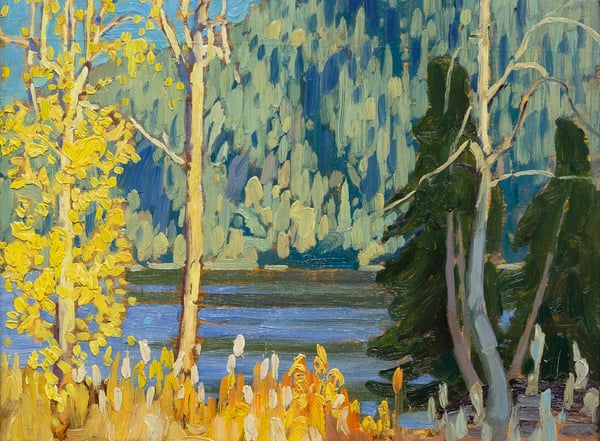
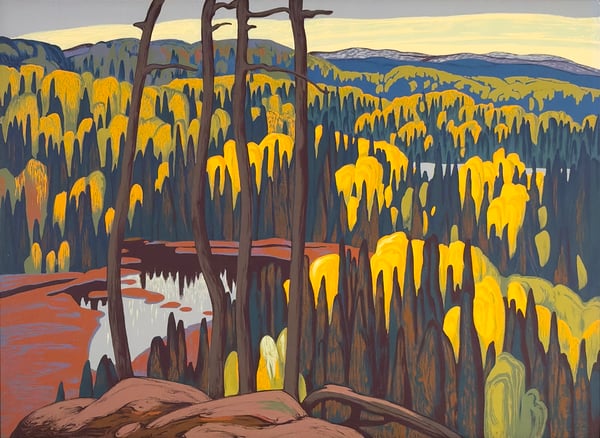
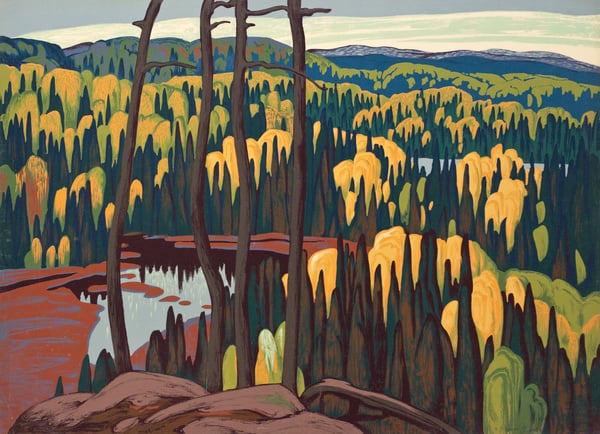
In March 1916, Harris enlisted in the Canadian Army for service in World War I. He was appointed a Lieutenant attached to the 10th Royal Grenadiers and served as a Musketry Instructional Officer at Camp Borden until May 1918 when he was medically discharged after suffering a nervous breakdown. In 1918 and 1919, Harris financed boxcar trips for artists of the later Group of Seven to the Algoma region, traveling along the Algoma Central Railway and painting areas such as the Montreal River and Agawa Canyon. He began sketching in oil en plein air as regular practice and used the sketches as guides in constructing his major canvases.
In May 1920, Harris, J.E.H. MacDonald, Franklin Carmichael, A.Y. Jackson, Frank Johnston, Arthur Lismer, and Frederick Varley formed the Group of Seven. In the fall of 1921, Harris ventured with Jackson beyond Algoma to Lake Superior's North Shore, where he would return annually for the next seven years. While his urban and Algoma paintings of the late 1910s and early 1920s were characterized by rich, bright colors and decorative compositional motifs, his Lake Superior work depicted features of the landscape in light over a vast body of water to compose a sublime order. Harris conveyed the spiritual side to these scenes through a more austere, stylized style with a limited palette.
In 1924, a sketching trip with Jackson to Jasper National Park in the Canadian Rockies marked the beginning of Harris's mountain subjects, which he continued to explore with annual sketching trips until 1929, exploring areas around Banff National Park, Yoho National Park, and Mount Robson Provincial Park. In 1930, Harris went on his last extended sketching trip, traveling to Greenland, the Canadian Arctic, and Labrador aboard the Royal Canadian Mounted Police supply ship SS Beothic for two months, during which time he completed over 50 sketches. The resulting Arctic canvases marked the end of his landscape period.
Harris later fell in love with Bess, the wife of his school-time friend F.B. Housser. He eventually left his wife of 24 years, Trixie, and married Bess Housser in 1934. He was threatened with charges of bigamy by Trixie's family, and later that year he and Bess moved to the United States. Harris moved to Hanover, New Hampshire in 1934, then Santa Fe, New Mexico in 1938, and finally Vancouver in 1940.
Harris was the only member of the Group of Seven to align himself with European and American forms of Modernism. In 1926, he represented Canada in the International Exhibition of Modern Art organized by the Société Anonyme and shown at the Brooklyn Museum, and helped bring the show to Toronto in 1927. In 1934, he painted his first abstract pictures, which depended partly on his desire to express ideas of the spirit and partly on his earlier landscapes. From 1936 on, Harris enthusiastically embraced abstract painting. He left all reference to landscape behind, and his work underwent changes towards a more organic form. In the 1950s, he painted his version of abstract expressionism.
After the disbanding of the Group of Seven in 1933, Harris and the other surviving members formed the Canadian Group of Painters, with Harris serving as its first president. In 1938, he helped organize the Transcendental Group of Painters in the United States. In 1941, he was a founder of the Federation of Canadian Artists and served as President from 1944 to 1947.
Harris received numerous honors including a gold medal at the Sesquicentennial International Exposition of Philadelphia in 1926, the Baltimore Museum of Art prize in 1931, honorary degrees from the University of British Columbia (1946), University of Toronto (1951), and University of Manitoba (1953), the Canada Council medal in 1961, and a Medal from the Royal Canadian Academy of Arts in 1969. In 1970, he was made a Companion of the Order of Canada, conferred posthumously. Bess died in 1969, and Harris died in Vancouver on January 29, 1970. His work is held in major collections including the National Gallery of Canada, Art Gallery of Ontario, and McMichael Canadian Art Collection.
More work by Lawren Harris