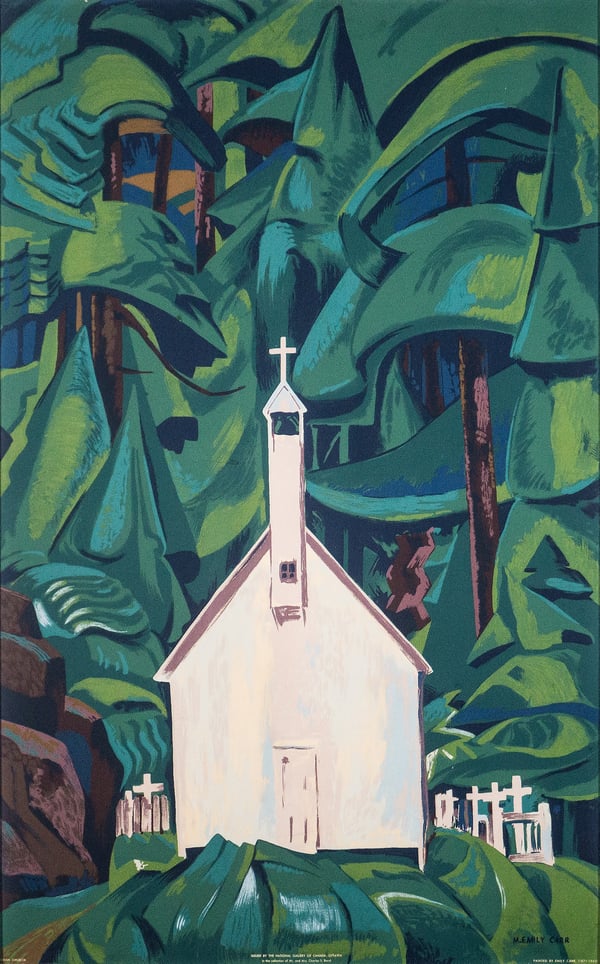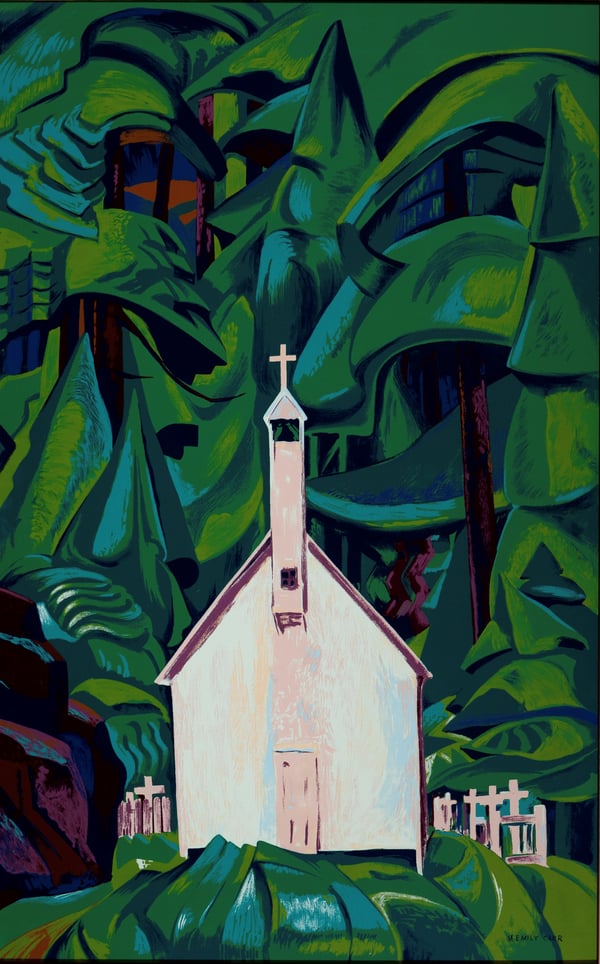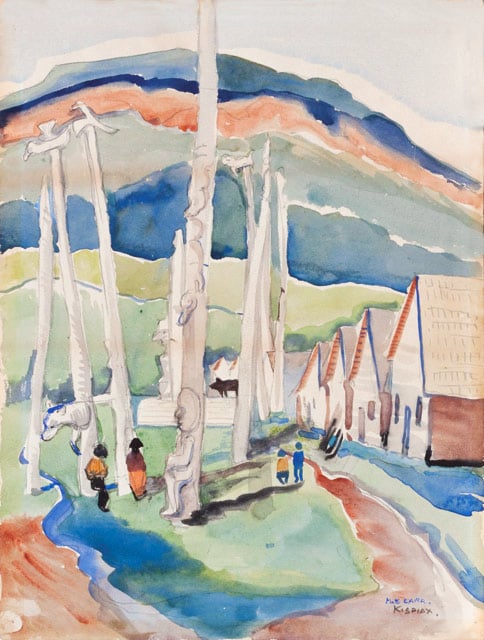
Kispiax Village Sketch
Sold
Emily Carr
1871 - 1945 CGP, GGA, RCA
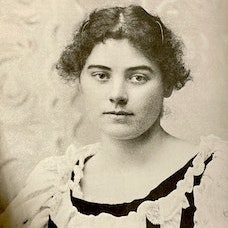
Emily Carr was born on December 13, 1871, in Victoria, British Columbia, the second youngest of nine children born to English parents Richard and Emily (Saunders) Carr. The family was raised in the English tradition in their home on Birdcage Walk (now Government Street) in the James Bay district of Victoria. Her mother died in 1886 and her father died in 1888, with her oldest sister Edith becoming guardian of the remaining children. After her parents' deaths in 1890, Carr pursued art seriously, studying at the California School of Design in San Francisco from 1890 to 1893. In 1898, she made the first of several sketching and painting trips to Aboriginal villages, staying near Ucluelet on the west coast of Vancouver Island, home to the Nuu-chah-nulth people, who gave her the Indigenous name Klee Wyck.
In 1899, Carr traveled to London to become a professional artist. She studied at the Westminster School of Art, then with John William Whiteley in Bushey, Hertfordshire, and at an art colony in St Ives, Cornwall with Julius Olsson and Algernon Talmage in 1901. After a nervous breakdown and convalescence, she returned to British Columbia in 1904. In 1907, she made a trip to Alaska with her sister Alice and decided on her artistic mission of documenting the "vanishing totems" and way of life of the First Nations. From 1908 to 1910, she made several trips to First Nations communities to record their art and villages.
In 1910, Carr returned to Europe to study. In Paris, she met modernist painter Harry Phelan Gibb, who introduced her to vibrant color and distortion. She enrolled at the Académie Colarossi, then took private lessons with John Duncan Fergusson. After illness, she joined Gibb in Crécy-en-Brie and St. Efflam, Brittany, where she fully embraced the Fauvist style of bold color and broad brushwork. She also studied with Frances Hodgkins in Concarneau, and two of her paintings were hung in the 1911 Salon d'Automne. In March 1912, she opened a studio in Vancouver and organized an exhibition of seventy works from her time in France, becoming the first artist to introduce Post-Impressionism to Vancouver. Later in 1912, she took a sketching trip to Haida Gwaii, the Upper Skeena River, and Alert Bay, documenting the art of the Haida, Gitxsan, and Tsimshian.
In 1913, obliged by financial considerations and perceiving that Vancouver's reaction to her work was not positive enough to support her career, Carr returned to Victoria. During the next 15 years, she did little painting, running a boarding house known as the "House of All Sorts," working as a potter, breeding dogs, and making pottery and rugs with Indigenous designs to sell to tourists. Over time, her work came to the attention of Marius Barbeau, a prominent ethnologist, who persuaded Eric Brown, Director of Canada's National Gallery, to visit Carr in 1927. Brown invited her to exhibit at the National Gallery as part of the Exhibition of Canadian West Coast Art: Native and Modern, where she sent 65 oil paintings along with samples of her pottery and rugs.
Carr made the trip east for the 1927 exhibition and met members of the Group of Seven in Toronto. Lawren Harris became an important mentor and friend, welcoming her into the ranks of Canada's leading modernists and inviting her to contribute to Group of Seven shows in 1930 and 1931. This encounter ended her artistic isolation and led to one of her most prolific periods. Her artistic direction was influenced by Harris's work, his advice, and his belief in Theosophy. In 1928, she invited Mark Tobey to teach a master class in her studio, furthering her understanding of modern art. She continued sketching trips through the late 1920s and 1930s. In 1933, she was a founding member of the Canadian Group of Painters. Recognition of her work grew steadily, with solo exhibitions at the Vancouver Art Gallery in 1938 and success at the Tate Gallery in London.
Carr suffered her first heart attack in 1937, and with her ability to travel curtailed, her focus shifted from painting to writing. With editorial assistance from Ira Dilworth, her first book, Klee Wyck, was published in 1941 and won the Governor General's Literary Award for non-fiction that same year. In 1942, she established the Emily Carr Trust and donated close to 170 paintings to the Vancouver Art Gallery. She had her only successful commercial show at the Dominion Gallery in Montreal in 1944. Carr died on March 2, 1945, at the James Bay Inn in Victoria, shortly before she was to have been awarded an honorary doctorate by the University of British Columbia. She has been designated a National Historic Person and is considered a Canadian national treasure and icon.
More work by Emily Carr