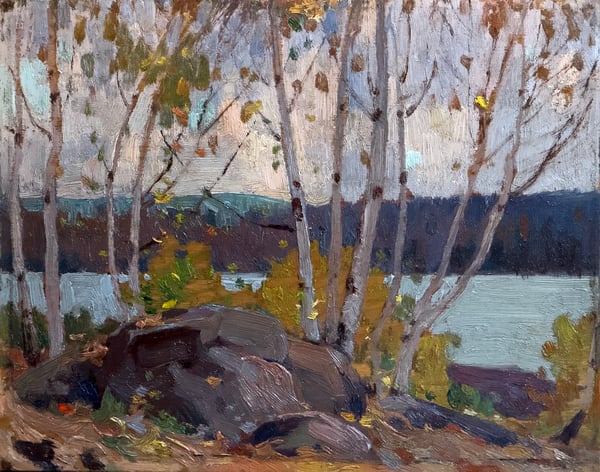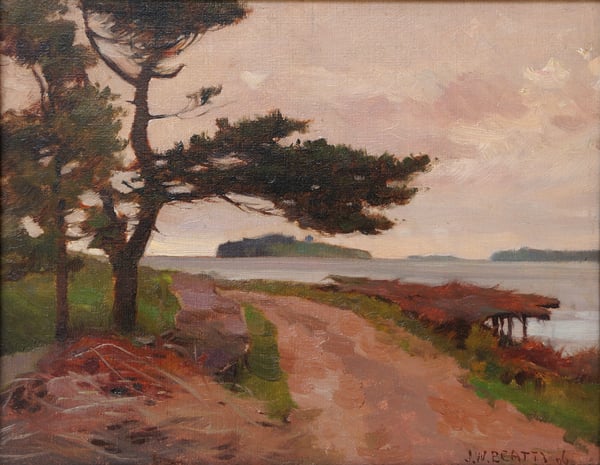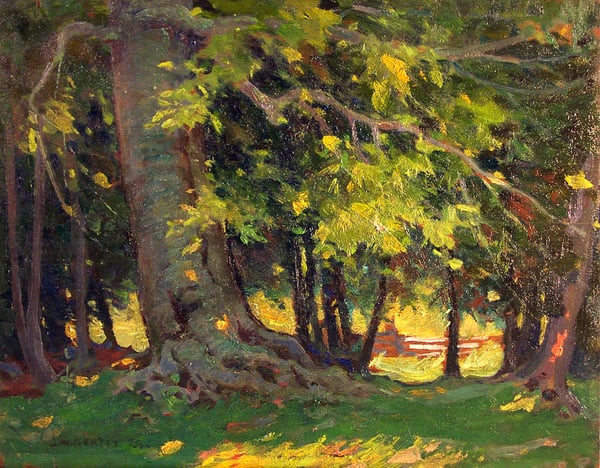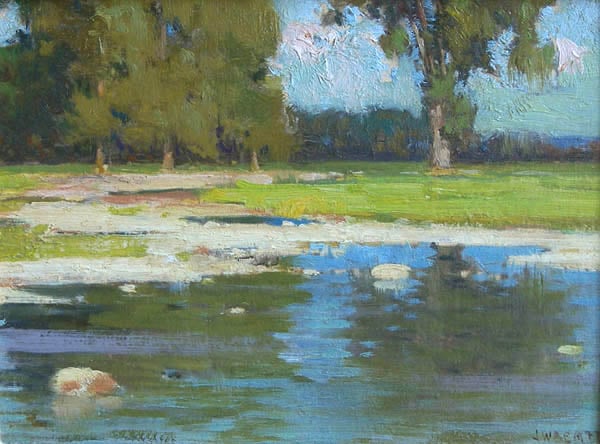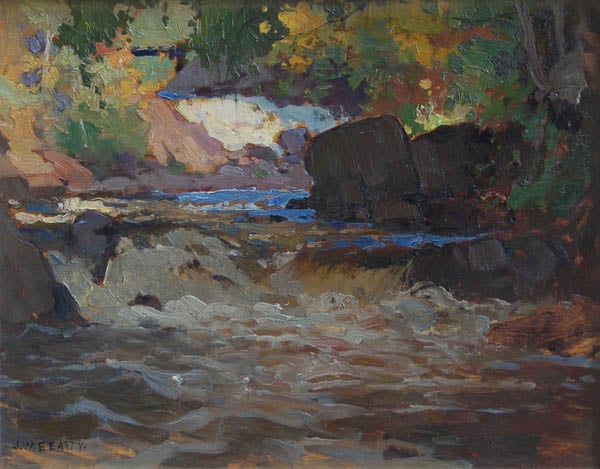
Brooks Falls, Parry Sound
Sold
John William Beatty
1869 - 1941
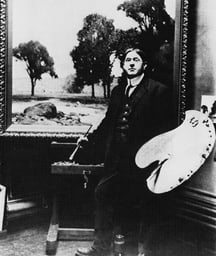
John William Beatty was born in Toronto, Ontario on May 30, 1869. His father was a sign and house painter who taught him the trade, and Beatty earned his journeyman's papers in 1885. He worked as a house painter before joining the newly formed Toronto Fire Department in 1889, where he remained until 1900. As a teenager, he had served as a bugler with the 10th Grenadiers in the North-West Rebellion of 1885. During his years with the fire department, Beatty spent his spare time painting still lifes and portraits of fellow firefighters, and studied art with William Cruikshank, F.M. Bell-Smith, and George Agnew Reid.
In 1900, after a successful solo exhibition, Beatty resigned from the fire department to study abroad. He and his wife Caroline sailed to Paris where he studied at the Académie Julian under Jean-Paul Laurens and Benjamin Constant, earning several awards for his figure drawing. He returned to Toronto in 1901, opened a studio, and began teaching at the Ontario School of Art and Design. From 1906 to 1909, Beatty returned to Europe, studying at the Académie Julian and Académie Colarossi in Paris, and attending London Chelsea Polytechnic. He traveled throughout Holland, Belgium, Italy, and Spain, creating dark, sombre paintings influenced by the Barbizon School and traditional French and Dutch landscape painting.
Returning to Toronto in 1909, Beatty began traveling to Northern Ontario to paint Canadian landscape subjects, becoming one of the first Toronto artists to sketch by canoe in these regions. In 1910, he painted "The Evening Cloud of the Northland," depicting a forest fire burning in distant hills. He later asked the National Gallery of Canada to exchange this work for his earlier painting "A Dutch Peasant," explaining "I am a Canadian. I would much rather be represented by a Canadian picture." The National Gallery acquired "The Evening Cloud of the Northland" in 1911, and it remains his masterpiece. Over time, his palette brightened from the grey tones of his European work to more vibrant colors.
Beatty was a member of the Arts and Letters Club where he developed friendships with artists including Lawren Harris, A.Y. Jackson, Tom Thomson, and Arthur Lismer. He undertook sketching trips with Harris as early as 1909 and had a studio in the Studio Building that Harris built to foster creativity among Canadian artists. In 1914, Beatty and Jackson were commissioned by the Canadian Northern Railway to paint in and around construction camps as the railway was laid through the Rocky Mountains. He also sketched in Algonquin Park with Jackson and Lismer that same year. Beatty was a friend and early influence on Tom Thomson, and in 1917 carved the stonework for the memorial cairn erected to Thomson at Canoe Lake.
In 1917, Beatty was appointed an Official War Artist for the Canadian Expeditionary Force, serving with Frederick Varley, Maurice Cullen, and Charles Walter Simpson. He was in Britain and France from March to October 1918. After his return, he withdrew from the more avant-garde activities of his Toronto colleagues and is known as a forerunner rather than a participant in the movement that became the Group of Seven in 1920.
Beatty taught at the Ontario College of Art from 1912 to 1941 and founded and ran the OCA summer school from 1913 to 1935. His teaching had significant influence on the development of art education in Ontario, as many school teachers attended the summer program. He was a member of the Ontario Society of Artists and the Royal Canadian Academy of Arts. His work is held in collections including the National Gallery of Canada, Art Gallery of Ontario, McMichael Canadian Collection, Hart House at the University of Toronto, Queen's University Art Centre, and the Canadian War Museum. Beatty died in Toronto on October 4, 1941.
More work by John William Beatty