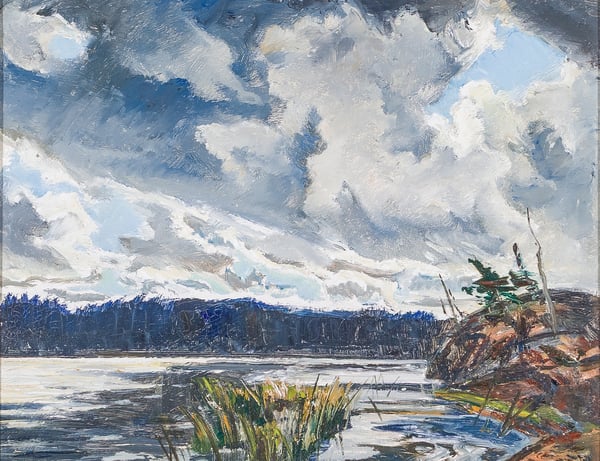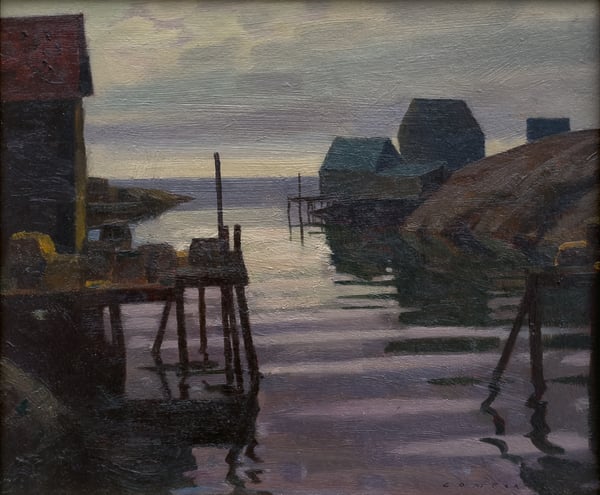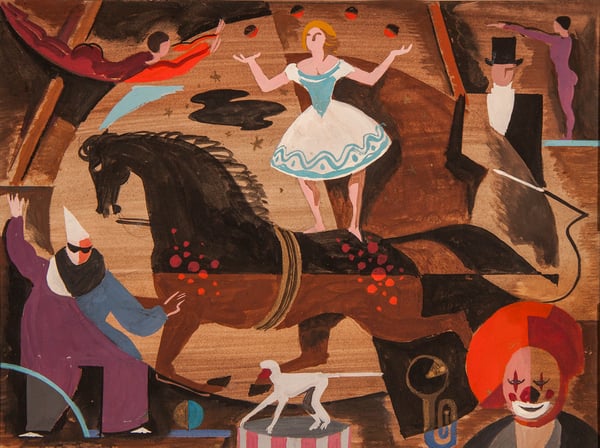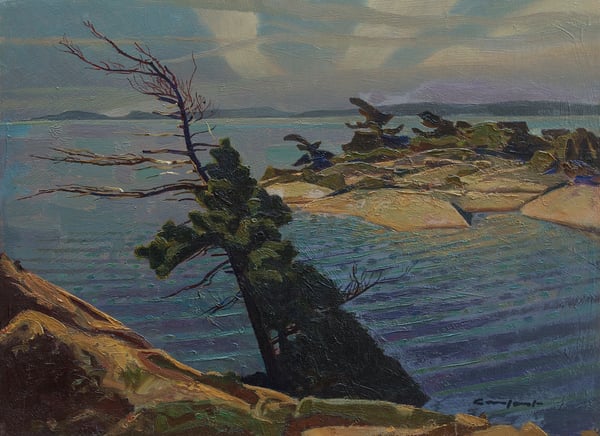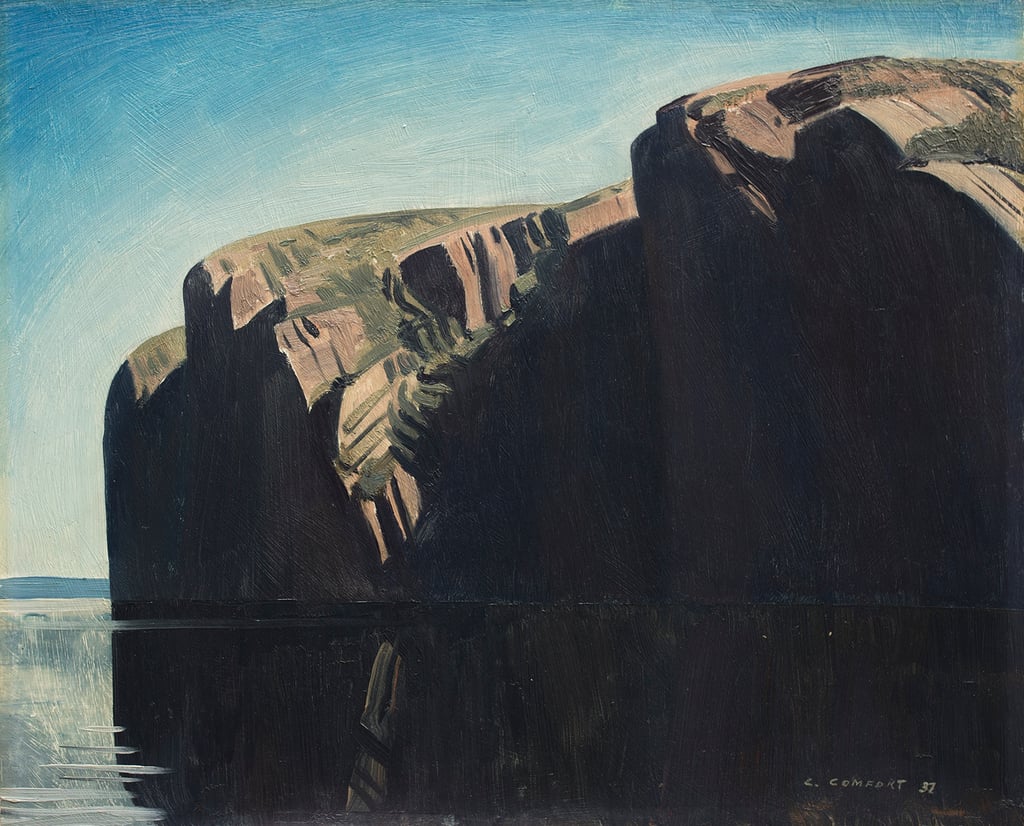
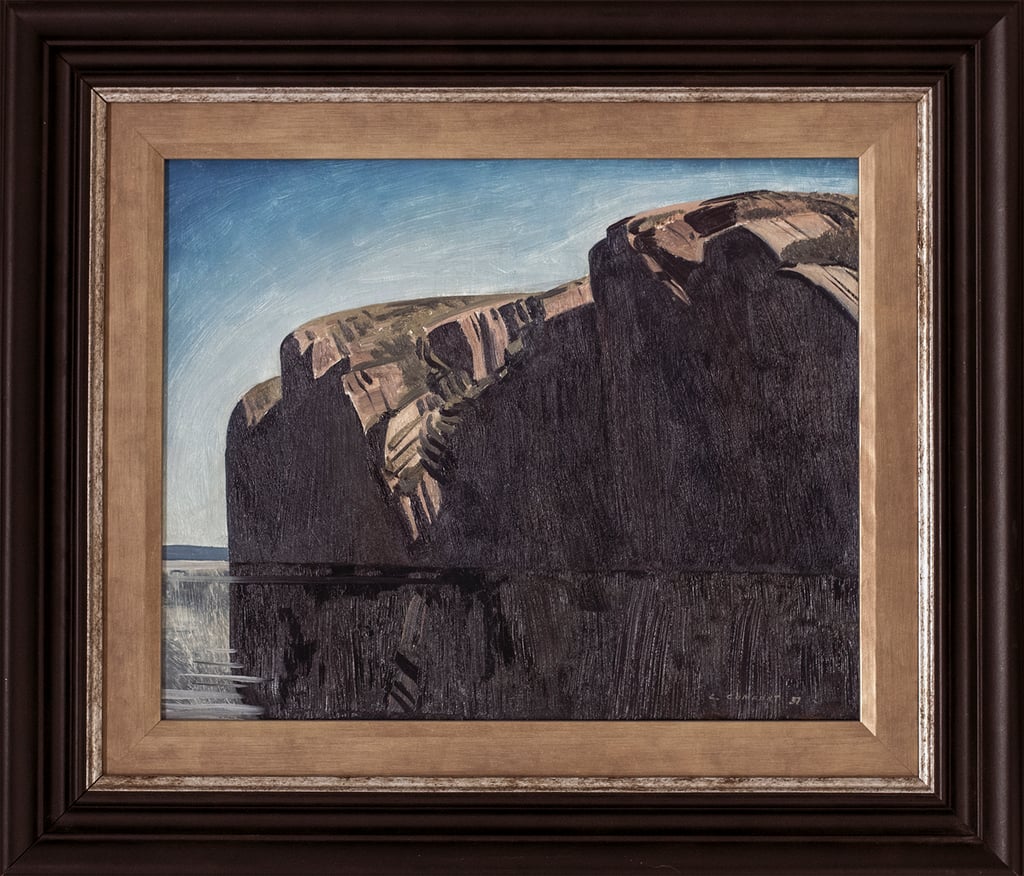
Northern Rocks IV (Bon Echo)
Sold
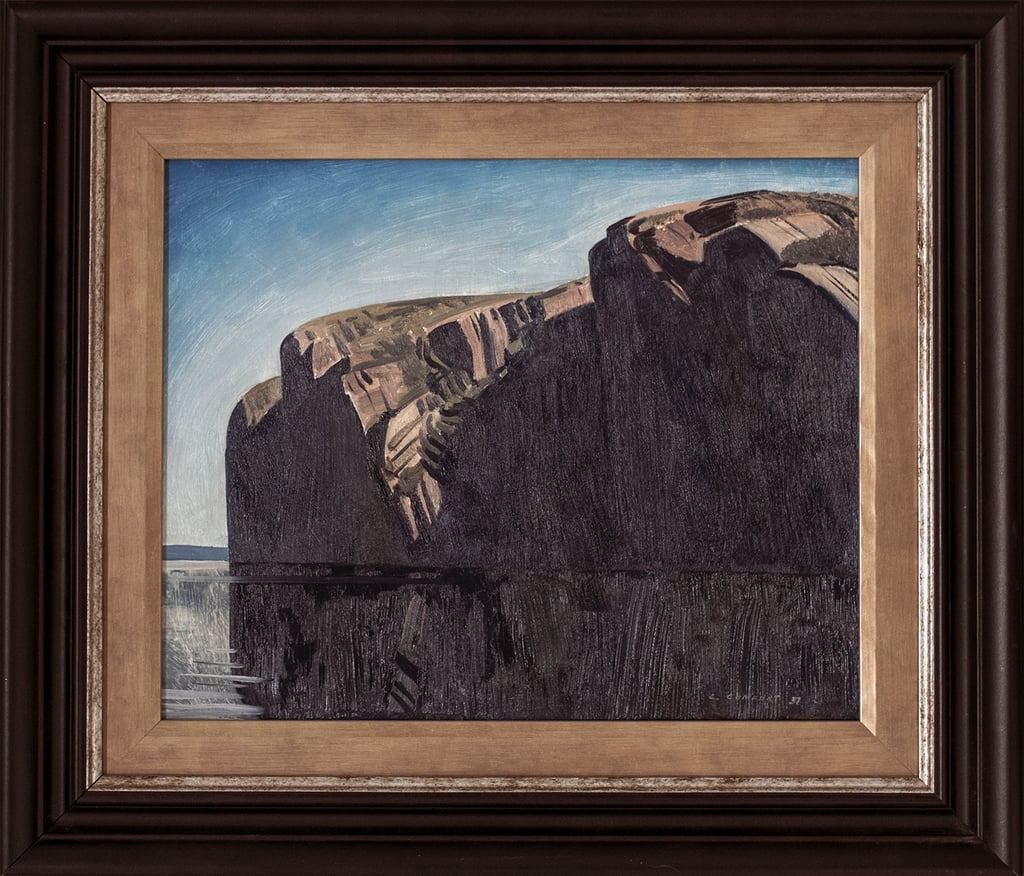
Charles Comfort
1900 - 1994 OC, OSA, CGP, CSGA, CSPWC, MSA, RCA
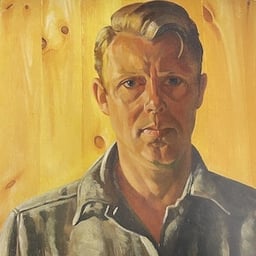
Charles Fraser Comfort was born near Edinburgh, Scotland, on July 22, 1900, and immigrated to Winnipeg, Manitoba, with his family in 1912. His artistic talent emerged early when he won his first art competition at age eight. By age fourteen, he had won another art contest judged by Frederick Henry Brigden, who recognized his ability and hired him at Brigden's commercial art firm in Winnipeg. While working at Brigden's, Comfort studied at the Winnipeg School of Art and later attended the Art Students League in New York from 1921 to 1923, studying under Robert Henri, E. Allen Tucker, and Vincent DuMond. This foundational training combined commercial design skills with fine art techniques that would characterize his entire career.
In 1925, Comfort moved to Toronto, where he was transferred to Brigden's Toronto office and became deeply involved in the city's art community. He joined the Arts and Letters Club, where he met members of the Group of Seven, and their 1920 inaugural exhibition profoundly influenced his landscape work. Comfort became a charter member of the Canadian Society of Painters in Water Colour in 1926, and his portrait "Louise" (of his wife) won honorable mention in the 1929 Willingdon Arts Competition. During the economically challenging 1930s, he formed a partnership with fellow artist Will Ogilvie and Harold Ayres, combining their skills in portrait painting, advertising layout, architectural decoration, and magazine illustration to sustain their practices. This collaboration allowed Comfort to pursue major mural commissions, including his 1932 decoration of the North American Life Building in Toronto.
Comfort's career as a muralist and teacher established him as a significant figure in Canadian art. He taught at the Ontario College of Art from 1935 to 1938 and at the University of Toronto from 1938 to 1960, specializing in mural painting and historical techniques. His major architectural commissions included the stone frieze for the Toronto Stock Exchange in 1937, considered the first modern interpretation of mural work in Canada, and murals for the International Nickel Company's pavilion at the 1937 Paris Exposition. His painting "Tadoussac" (1935), which reduced the harbor scene to basic geometric forms, demonstrated his ability to synthesize modernist influences with Canadian landscape traditions and was acquired by the National Gallery of Canada.
In 1943, Comfort was appointed Senior Official War Artist with the rank of Captain, serving with the First Canadian Infantry Division in Italy and other European units until 1946. His war experiences produced some of Canada's most celebrated military art, including "The Hitler Line" and a reconstruction of the Dieppe Raid, along with numerous watercolor sketches completed near battlefields. He documented his wartime experiences in detailed diaries, later published as "Artist at War" (1956), which provided both visual and written records of the Canadian Army's campaigns from England through Italy. His war art captured not only military action but also the psychological impact of combat, establishing him as one of Canada's most important war artists.
Comfort played crucial roles in Canadian cultural institutions throughout his career. He was instrumental in organizing the 1941 Kingston Conference, helped initiate Canada's War Art program, and was a founding member of the Federation of Canadian Artists. He contributed to the 1951 Massey Report, which led to the establishment of the Canada Council for the Arts. From 1957 to 1960, he served as President of the Royal Canadian Academy of Arts, and from 1960 to 1965, he was Director of the National Gallery of Canada, becoming the only practicing artist to hold this position. During his directorship, he established the position of Curator of War Art and significantly improved the care and storage of the war collections.
Comfort's extensive honors reflected his contributions to Canadian art and culture. He received an honorary doctorate from Mount Allison University in 1958, the Canadian Centennial Medal in 1967, and was appointed Officer of the Order of Canada in 1972. His work is represented in major collections including the National Gallery of Canada, the Art Gallery of Ontario, the Canadian War Museum, and Hart House at the University of Toronto. Beyond his individual artistic achievements, Comfort's legacy includes his role in establishing institutional frameworks that supported Canadian artists and his efforts to integrate art with broader social and cultural life. He died in Ottawa on July 5, 1994, leaving behind a comprehensive body of work spanning portraiture, landscape, murals, and war art that documented Canada's artistic and military history over seven decades.